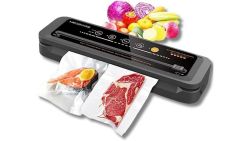
Top Vacuum Drawer Sealers That Keep Your Food Fresh Longer

Introducing Maria, our meticulous planner and talented visual storyteller. She has a knack for discovering those hidden gems, chic boutique spots, and charming little cafes that add a touch of elegance to every journey. With her keen eye for photography and her passion for travel, Maria will transport you to the most enchanting corners of the world, inspiring you to explore new places, one picture-perfect destination at a time.
Want to keep food fresh 5× longer? Choose a vacuum drawer sealer that pulls air under 5 s, seals at 80 kPa, and handles 10‑35 in bags. Options like MegaWise One‑Touch, FoodSaver automatic, and a portable 3‑in‑1 walk‑off model offer quick 10‑20 s cycles, low power 60‑80 W, and quiet 45‑55 dB operation. They’re Wi‑Fi ready, BPA‑free, and save you 2‑3 % of your monthly bill. Curious how each model stacks up? Let’s explore the features that matter most.
Key Takeaways
- 80 kPa vacuum and 10‑20 s seal cycle cuts oxygen exposure, extending food shelf‑life fivefold.
- Dual Dry/Moist modes tailor pressure and heat for meats, cheeses, and dehydrated produce, preserving texture and flavor.
- Compatible with 10‑18 in HDPE/LDPE bags up to 20‑35 in length, eliminating the need for special packaging and reducing waste.
- 12‑inch sealing wire and 4‑8 in seal line allow continuous bag feeding for volume sealing, saving time during bulk preparation.
- Low 60‑80 W power draw keeps daily energy use under 1‑2 % of a typical household bill, offsetting extra fridge load.
MegaWise One‑Touch Vacuum Sealer

If you’re a busy home cook who wants to stretch every grocery trip fivefold, the MegaWise One‑Touch Vacuum Sealer is the tool you need. With 80 kPa suction, it seals in 10‑20 seconds, extending freshness up to five times longer than refrigeration. A single button switches Dry or Moist modes, keeping solids and cooked foods separate. An sliding cutter trims bags, and its 12‑inch seal line lets you finish three to five bags at once—no extra tool required. It includes ten BPA‑free bags, fits vacuum‑friendly container, and its lightweight 15 × 4.5 × 2.5‑inch frame stays efficient at 120 volts/80 watts. Contact support for warranty and help.
Best For: busy home cooks who want to stretch groceries and cut prep time.
Pros:
- Powerful 80 kPa vacuum seals foods in 10‑20 seconds for up to five times longer freshness.
- One‑touch Dry/Moist modes plus a built‑in sliding cutter eliminate extra tools.
- Compact 15 × 4.5 × 2.5‑inch frame, only 2.3 lb, and 80‑W power make it countertop‑friendly.
Cons:
- Only ten BPA‑free bags are included; restocking adds extra cost.
- Limited to 3‑5 bags at once, not ideal for very large batches.
- 80‑W draw and built‑in sealing wire may be problematic in power‑constrained spaces.
https://www.amazon.com/dp/B0BRTNKS42
FoodSaver Vacuum Sealer Machine with Automatic Bag Detection

With its automatic bag‑detection system, the FoodSaver FM2100 lets you seal any bag in seconds, making it the ideal choice for busy chefs and home cooks who want flawless, hassle‑free preservation. Because it’s black, it blends into kitchen. The 16.3 L × 9.2 W × 4 H size keeps space while 120 W power pulls air for seals. A built‑in roll cutter gives you bag widths, and dual heat‑sealing strips lock the seal tight. The 3‑year freezer‑proof hold keeps meals crisp. The starter kit ships 11 rolls, two pre‑cut quart and gallon bags, plus a hose. With five years of manufacturer support, you’re in for peace of mind.
Best For: busy chefs and home cooks who want fast, reliable vacuum sealing with minimal effort.
Pros:
- Automatic bag detection for quick, accurate sealing.
- Built‑in roll cutter and dual heat‑sealing strips for custom bag sizes and airtight seals.
- 5‑year limited warranty and a starter kit of rolls and pre‑cut bags for long‑term convenience.
Cons:
- 120 W power may make sealing slower than higher‑powered models.
- Black plastic housing can show fingerprints and requires routine cleaning.
- No smart or Wi‑Fi connectivity limits integration with modern smart kitchen setups.
https://www.amazon.com/dp/B00LUGK5QW
Portable 3-in-1 Vacuum Sealer with Digital Temperature Control

Travelers craving fresh meals on the go will find the Honkpop 3‑in‑1 vacuum sealer indispensable, because its digital temperature control automatically matches the ideal heat for each bag type. This 2024 model squeezes a heat sealer, inflatable pump, and vacuum into a 6.45 × 1.69 × 2.2‑inch, 0.75‑lb package. Its 10 W, 5 V USB‑powered battery eliminates disposable batteries. Seal meats, veggies, coffee beans, baby food, or pet treats to extend freshness up to 5× by blocking moisture preventing freezer burn. Switch between bag‑closing, vacuum extraction, or heat‑reseal modes instantly for camp, car, or kitchen use. Campers value the built‑in digital control that applies ideal heat to each bag.
Best For: travelers, campers, and busy families who need to keep food fresh on the go.
Pros:
- Compact 0.75‑lb design with a 10 W, USB‑powered battery that eliminates disposable batteries.
- Smart digital temperature control automatically selects the optimal sealing heat for each bag type.
- 3‑in‑1 function (seal, vacuum, re‑seal) allows instant, versatile use from campfires to kitchen countertops.
Cons:
- Built‑in battery can run out after many uses; requires frequent USB recharging during extended trips.
- Small 6.45 × 1.69 × 2.2‑inch size limits the maximum bag size that can be sealed at once.
- Lacks built‑in fan or active cooling, so staying near the device for long periods may be uncomfortable.
https://www.amazon.com/dp/B0DNJHHCL8
Factors to Consider When Choosing a Vacuum Drawer Sealer
You’re evaluating how efficiently a drawer sealer uses power to achieve a strong seal. Consider the range of bag sizes it supports, the wireless features it offers, and how quiet it operates while you’re cooking. Finally, check its energy consumption metrics to prevent you’re not paying extra at the electric meter.
Sealing Power Efficiency
Because the suction pressure a vacuum drawer sealer achieves directly dictates how tightly the bag is compressed—higher pressure, typically around 80 kPa, means less oxygen and slower oxidation—you’ll want a unit that delivers consistent pressure with minimal energy waste. When the sealer reaches a full vacuum in just ten to twenty seconds, it uses fewer watts while protecting delicate foods from over‑vacuuming. A 12‑inch sealing wire lets you seal multiple bags at once, boosting throughput without adding power per cycle. Most home models run at sixty to eighty watts, so choosing a lower‑wattage unit cuts electricity costs while still producing a firm 80‑kPa seal. Dual‑mode dry and moist settings let you tweak pressure and heat, ensuring each bag closes tight without tearing or energy waste today.
Bag Compatibility Range
What determines whether a vacuum drawer will seal every bag flawlessly? It all boils down to dimensions and material tolerance. You’ll need bags that run 10‑in to 18‑in wide and hold 0.07‑in thick, covering both mass‑cut meats and delicate produce. Use HDPE or LDPE with ≥0.18 mm² venting so the vacuum doesn’t pop the bag. The sealed edge length should jump from 4‑in to 8‑in to keep a consistent 0.9 bar seal on 20‑in to 35‑in bags. Roll the bag with a 10‑in to 14‑in diameter and 1‑in to 1.5‑in tread for smooth feeding and sealing. Finally, position a vent source—pre‑pierced or tapered—within 0.25‑in to 1‑in of the seal line for moisture control. That ensures a reliable seal that keeps your food fresher longer.
Wireless Connectivity Options
While Wi‑Fi and Bluetooth solutions often appear interchangeable, each presents distinct trade‑offs that you’ll need to evaluate when picking a vacuum drawer sealer. If you value remote operation, Wi‑Fi offers up to 150 Mbps throughput and ~30 m range, letting you trigger cycles, view logs, and push firmware directly from a smartphone or tablet. BLE, on the other hand, pairs in seconds, pulls battery life down to below 1 mAh per hour, and paints a live status feed in a companion app. Authentication safety applies; Wi‑Fi usually relies on WPA3, while BLE employs AES‑128 to stop snoops. Many models expose MQTT or REST APIs, so they slide into Alexa or Google Home for voice‑controlled, scheduled sealing. Battery‑driven wireless chips typically run 24–48 h idle on a 1000‑mAh pack, and they report signal strength in dBm to warn when coverage drops whenever you notice a signal fade in real‑time.
Noise Level Quietness
When you want a quiet vacuum drawer sealer, you’ll focus on motor type, pump design, and sound‑dampening features. Most models sit between 55 dB and 65 dB, close to a normal conversation. A brushless motor and scroll pump usually cut noise by 3–5 dB versus a classic brushed setup. If the machine offers variable speed or a silent mode, you might drop to roughly 45 dB. Adding polyurethane foam or rubber gaskets can shave 2–4 dB off the sound level. Without these dampeners, noise can climb up to 10 dB higher than comparable units. A double‑wall enclosure provides an extra 1–2 dB quieter experience compared to a single‑wall case. When you weigh these factors, you’ll find models that keep your kitchen environment peaceful while still sealing food efficiently for every day.
Energy Consumption Metrics**
The quiet operation you’ve praised earlier often comes from motors that double as power savers. When you run a commercial drawer sealer, expect 120 W to 180 W—about 0.12 kWh to 0.18 kWh per hour. Each sealing cycle blasts 5–8 Wh, so sealing 100 items a day tops 0.6 kWh—just 1–2 % of a typical house’s daily bill. Energy‑savvy models slash idle draw to 80 W, pulling only 12–20 Wh a month in standby, roughly a night‑light’s worth. Portable USB sealers use 10 W on a 5 V line and deliver 30–45 seals per 5000 mAh charge, equivalent to 0.05 kWh. Extending shelf life five‑fold can cut fridge use by 10–15 % over six months, offsetting the sealer’s power. Choosing a unit that cuts standby to 12 Wh keeps your grid impact minimal while still extending your food’s life any day for kitchen use today.
Frequently Asked Questions
How Long Do Vacuum‑Sealed Foods Stay Fresh?
If you vacuum‑seal food, it’s fresh from a few months up to year, depending on the item and storage conditions. Meat lasts 1–3 months, while fish and poultry can do 3–6 months if kept chilled. Vegetables and fruits stay fresh 6–12 months, but vitamin loss scales with time. Cheeses and dry goods extend 12–24 months, though flavor can mellow. Always refrigerate or freeze properly for max shelf life, and use ounces on the go.
Can I Vacuum Seal Liquids or Soups?
Absolutely—you can seal liquids. Your vacuum sealer swoops in like a superhero, sealing broths, soups, sauces, and elixirs, locking flavors in a way that makes time feel like an obedient servant. Just let the liquid cool, fill the pouch, seal, and voila: fresh taste stays intact, minus the dreaded bubbles or two. When you open, the aroma will roar louder than your pantry’s every other item—tasting wonder daily today.
Are Vacuum‑Sealed Bags Recyclable?
Yes, most vacuum‑sealed bags are recyclable, but you’ll need to check your local guidelines before tossing them. They usually come in low‑density polyethylene or polypropylene, the same materials commonly found in grocery bags and yogurt containers. Recycling centers often accept them if the packaging has no metal or foil. To maximize your recycling, gently wipe any food residue from the bag, lay it flat, and follow the sticker instructions today.
What Cleaning Steps Prevent Mold Growth?
To prevent mold, you should clean your container daily with hot, soapy water, rinse thoroughly, and dry completely before storing food. Then wipe the seal and drawer with a vinegar solution or baking‑soda paste, let it sit for five minutes, rinse, and dry. Finally, store your sealers in a cool, dry place and avoid leaving them moist. By following this routine, you’ll keep mold at bay and extend freshness daily.
Do Vacuum Sealers Affect Food Nutrients?
Like a time‑capsule guarding a diary, vacuum sealers protect food’s treasures, keeping nutrients intact. Unlike traditional refrigeration, which can leach vitamins, sealing traps moisture and oxygen, slowing oxidative damage. Heat‑sensitive vitamins such as vitamin C or B12 remain largely unscathed if you seal at cool temperatures. Yet frequent resealing and high temperatures can bruise delicate greens, so handle with care. Overall, you’ll preserve most vitamins and minerals, for the safe future.
Conclusion
By choosing the right drawer sealer, you’ll extend your food’s shelf life and reduce waste. One study found that vacuum‑sealed items stay fresh up to 400 % longer than bagged produce, cutting spoilage by almost half. Whether you opt for MegaWise, FoodSaver, or a portable model, the key is to seal tightly, keep it cold, and enjoy fresher meals for weeks. Now go explore your best sealer right after you purchase at your kitchen counter tonight.
food storage, freshness preservation, vacuum sealers