Top Under‑Stair Storage Cabinets to Maximize Space
Ready to transform hidden stair space? First, choose a heavy‑duty ball‑bearing slide that supports up to 265 lb and guarantees smooth, silent motion with a 53.8 mm clearance so you can stack safely. Next, add a mobile laundry unit with five polypropylene baskets for quick access and a sleek L‑shaped bookcase that offers 13 compartments for books and décor. Pair those with adjustable under‑shelf baskets and a slim bathroom cabinet on wheels. Curiosity? You’ll find more immediately.
Key Takeaways
- Choose cabinets with 7–8 in depth and 70–80 in vertical clearance, so stairs remain fully usable.
- Opt for the L‑shaped corner bookcase (61.5 in tall, 49.25 in wide) to maximize vertical storage and hold up to 75 lb.
- Select heavy‑duty sliding mechanisms (265‑lb rails, 2 mm steel, anti‑collision pads) for smooth access and 100 lb load capacity.
- Install adjustable under‑shelf baskets (up to 35 lb, 10–17 in width) to fit irregular items and maximize usable space without drilling.
- Match finishes to warm walnut trim and use tool‑free assembly to keep aesthetics cohesive and simplify installation.
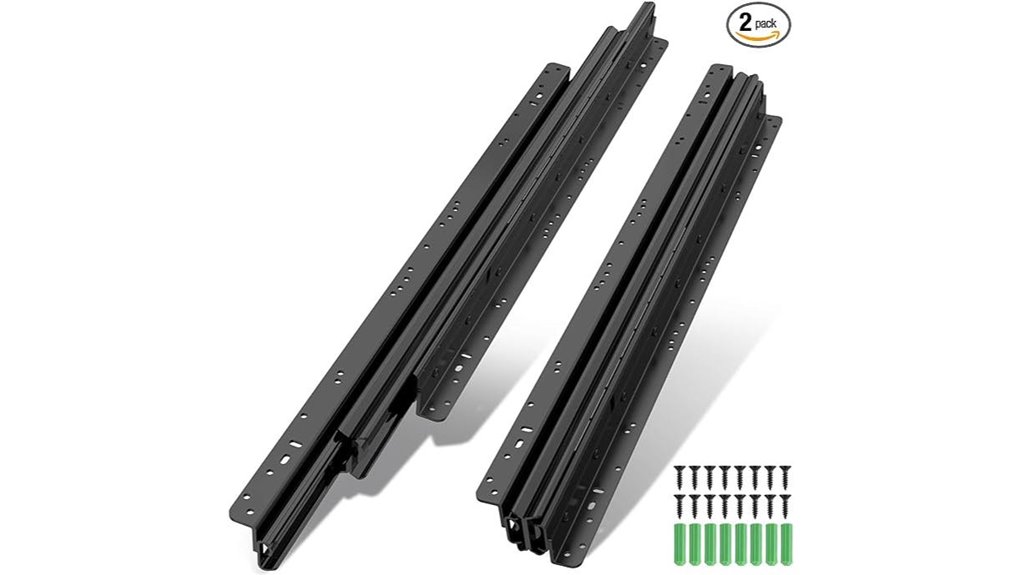
Under-Stair Heavy Duty Ball Bearing Slide, 265 lb

If your floor space is tight but your storage needs are heavy, the Polar Tangro 265‑lb heavy‑duty ball‑bearing slide is the swing‑door to success. You’ll fit it behind almost any set of stairs because the rail comes in 16‑, 24‑, 32‑, or 40‑inch lengths and can lift 265 lb per slide. Made of 2.0 mm high‑density cold‑rolled steel, the rail’s black electrophoretic coating resists corrosion, while dual rows of solid steel ball bearings offer smooth, silent glide. Installation is straightforward: the bottom‑mounted rail comes pre‑drilled for 16 self‑tapping screws and 8 expansion anchors, needing only 53.8 mm clearance. It offers a standard warranty and 30‑day return.
Best For: homeowners and business managers needing a highly durable, low‑maintenance slide to store heavy items behind stairs in small spaces.
Pros:
- Robust 265 lb load capacity per slide ensures it handles heavy goods.
- 2 mm high‑density cold‑rolled steel rails with electrophoretic coating offer excellent corrosion resistance.
- Dual rows of solid steel ball bearings provide silent, smooth glide and a self‑closing action.
Cons:
- Requires a minimum vertical clearance of 53.8 mm, limiting use in very tight stairwell clearances.
- Installation relies on pre‑drilled holes; additional fasteners or anchors may be needed in non‑standard bases.
- The heavy construction can make the rail and hardware bulkier, which may be a consideration for very tight or narrow stairwell widths.
https://www.amazon.com/dp/B0G7TWLW7J
Mobile Laundry Room Shelving Unit with 5 Baskets

For tight laundry or under‑stairs areas, this mobile unit’s 4.75‑inch width and integrated caster wheels let you tuck it in a narrow gap and pull it out for quick access—making it ideal for homeowners who need space‑saving solutions for laundry, cleaning supplies, or pet items.
The “Laundry Room Organizer” offers five baskets for goods, spices, detergents, pet toys, or tools. At 21.5″ L × 4.7″ W × 52″ H, it fits narrow gaps and holds up to 60 lb. Made from durable polypropylene, its white finish wipes clean. Slide‑out rails keep it stable, and assembly takes minutes, so you’ll find it ready fast.
Best For: homeowners with narrow laundry rooms or tight under‑stairs spaces needing a quick‑access, mobile storage solution for laundry, cleaning supplies, or pet items.
Pros:
- Five spacious baskets accommodate a wide variety of items, from detergents to kitchen staples.
- Slide‑out rails and sturdy casters keep the unit stable and easily movable while keeping the footprint narrow at 4.75″.
- Durable polypropylene construction and a clean white finish offer long‑term resilience and effortless maintenance.
Cons:
- Requires a flat surface or countertop for stable placement.
- Assembly is needed, although it takes only a few minutes.
- No built‑in locking mechanism on the casters may cause accidental movement in high‑traffic areas.
https://www.amazon.com/dp/B076DJSGFY
Catrina 10-Cube L-Shaped Modern Bookcase with Drawer

Designed to fit snugly into corner stairwells, the Catrina 10‑Cube L‑Shaped Modern Bookcase turns tight, awkward spaces into organized storage zones. You’ll find it stylish in contemporary white, with a ladder‑shaped corner that maximizes vertical space. The unit offers 13 compartments: five hinged doors, two roomy drawers for small items, and six open shelves perfect for books, décor, or frames. Measuring 49.25″ wide, 11.5″ deep, and 61.5″ tall, it weighs 98 lbs yet can hold up to 75 lbs. Assembly takes one to two hours, and the sturdy wood panels stay clean with a quick dry cloth. For every room.
Best For: a homeowner or renter with a corner space who wants an elegant, organized solution for books, décor, or office supplies.
Pros:
- 13 versatile compartments allow for stylish storage and display.
- White, contemporary design fits seamlessly into modern interiors.
- Easy assembly (1–2 hrs) and simple maintenance (dry cloth wipe).
Cons:
- Fixed size and style limit customization options.
- Weight capacity (≤ 75 lb) may not suit heavy items or walls.
- Requires a solid corner; not ideal for uneven or narrow corners.
https://www.amazon.com/dp/B01FXCIMDQ
2 Pack Under-Shelf Storage Baskets – White

With a 35‑lb capacity and an adjustable width from 10.04 to 16.81 in, these 2‑pack white baskets let you transform any cabinet or pantry overhang into sturdy, organized storage—ideal for keeping kitchen staples, bathroom toiletries, or office supplies within easy reach. You slide them in effortlessly behind any shelf edge, then lock into place with simple screws—no drilling, no tools, just a minute of assembly. The sturdy, powder‑coated metal frame resists rust and scratches, while the 1‑mm support plate and 3‑mm thickened edges keep them tight even with heavy loads. Ideal for spices, tortillas, soaps, files, or detergent bags daily.
Best For: homeowners, renters, and office managers who want to turn unused shelf overhangs into sturdy, tool‑free storage for kitchen staples, bathroom supplies, or desk items.
Pros:
- Heavy‑duty, powder‑coated metal construction that handles up to 35 lb without sagging.
- Adjustable width (10.04–16.81 in) and tool‑free, one‑minute assembly—no drilling required.
- All‑metal design resists rust, scratches, and dirt, offering long‑lasting durability.
Cons:
- Higher upfront cost compared to standard plastic baskets.
- Extra weight may be excessive for very light, infrequently used items.
- Requires a shelf overhang ≤1.3 in thick; may not fit ultra‑thin cabinets or surface‑mounted shelves.
https://www.amazon.com/dp/B0D8BJBD9N
4-Tier Slim Bathroom Storage Cabinet with Wheels

Because your bathroom space is tight, the four‑tier cabinet folds flat when not in use and glides easily on its wheels. You’ll appreciate its 65.35‑inch height, 14.57‑inch width, and 11.42‑inch depth—perfect for narrow corners. Each tier holds adjustable shelves, giving you three shelf‑height options and up to 40 % more utilization. The single‑layer load‑bearing design keeps the cabinet from sinking while supporting heavy items. Made from all‑plastic panels with rounded corners, the unit’s 4‑button lock boosts anti‑shake stability, and magnetic seals guard against dust. Assembly is tool‑free, and its 16.45‑lb weight makes relocation a breeze. You’ll keep everything organized and accessible.
Best For: people who need compact, portable storage for tight corners—ideal for small bathrooms, kitchens, or dorm rooms.
Pros:
- Space‑saving 4‑tier design fits narrow corners and folds flat when not in use.
- Adjustable shelves give three height options and up to 40 % more usable space.
- Easy mobility with wheels, 4‑button lock, and magnetic seals for dust‑proofing.
Cons:
- Shallow depth (11.42 in.) limits the size of items that can be stored.
- All‑plastic build may show wear over time and lacks the durability of metal units.
- No built‑in doors or privacy, so items are exposed to light and pets.
https://www.amazon.com/dp/B0F26KTK2Q
Factors to Consider When Choosing an Under-Stair Storage Cabinet
First, you must measure your space to confirm the cabinet’s size and clearance fit your stairs and foot traffic.
Next, evaluate load capacity, material durability, and whether a sliding mechanism will meet your accessibility needs.
Finally, assess how complex installation will be, so you can decide if you’ll need professional help.
Size And Clearance
If you want an under‑stair cabinet that slides out unimpeded, start by checking the vertical clearance behind the landing—at least 53.8 mm (2.12 in) is needed. Next, measure the depth: stay within 10–12 in to keep the cabinet from hitting the stringers and allow easy passage. Align the width with the stairwell’s narrowest point—standard two‑step stairs usually max out at 12–15 in, so keep your unit within that limit. Height matters too; each tread is 7–8 in deep, so a ten‑step run gives roughly 70–80 in of vertical space. Design the cabinet so its height tops out around 70 in, leaving enough room for foot clearance and safe movement. Finally, verify the cabinet’s thickness and framing don’t eat into the available clearance, keeping enough space for operation in your home right.
Load Capacity
Ensuring you’ve a cabinet that can hold the weight you plan to store is as important as fitting it into the space.
Start by checking each unit’s maximum load rating—most under‑stair designs support between 50 lb and over 250 lb, so pick one that tops your expected load.
Match the listed capacity to the cabinet’s structural materials and construction type, whether it’s reinforced steel or solid panels with double‑sided slats.
Check mounting brackets too—anchors into studs must be rated at least the cabinet’s max weight, otherwise you risk collapse.
Internal layout matters, too; drawers, shelves, or bins with anti‑slip bottoms spread weight evenly, letting you rack heavier items safely.
Finally, add a safety margin—pick a cabinet rated 20 % above the heaviest item you plan to store.
Material Durability
Choosing durable materials for under‑stair cabinets sets the foundation for longevity. You’ll want cold‑rolled steel rails—2.0 mm thick—that can handle 265 lb per slide, giving you super stiffness and impact resistance versus thinner mild steel. Powder‑coated metal baskets, with 1 mm iron support plates and 3 mm reinforced junction zones, keep their shape under 35 lb loads while resisting rust and scratches. A high‑density cold‑rolled steel core compresses less, extending fatigue life for long‑term use. Coating metal with hard polyurethane or epoxy adds a protective barrier against corrosion, preserving the underlying surface. Lightweight polypropylene shelves also endure up to 60 lb without denting or cracking, offering a durable, lightweight option for everyday storage. When you combine these materials, you’ll create a cabinet that resists wear and saves maintenance costs today.
Sliding Mechanism
When you’ve picked high‑density cold‑rolled steel rails and lightweight polypropylene shelves, pairing them with a compatible sliding mechanism becomes the next step. Opt for ball‑bearing slides crafted from 2.0 mm steel: they move quietly and support up to 265 lb per rail, keeping your belongings steady. A telescopic design eliminates dead zones, letting the shelf extend fully and squeezing every inch of space. Make sure you leave at least 53.8 mm (2.12 in) of clearance below the slide to avoid contact with stair head or support posts. Anti‑collision rubber pads on the rails damp vibration, extending the mechanism’s life even with frequent use. Finally, choose a system that mounts with 16 self‑tapping screws and 8 expansion anchors—tool‑free and compatible with both wooden and metal bases here.
Installation Complexity
If you’re aiming to tuck a storage cabinet beneath your stair, the first thing to check is the vertical clearance—at least 53.8 mm (≈2.12 in) is required so the slide rails can move freely. First, double‑check that the wall studs align with the pre‑drilled tracks; the kit usually lists 16 self‑tapping screws and 8 expansion anchors. Use the matching drill bits—14 mm for screws, 8 mm for anchors—to avoid stripping. If you prefer a tool‑free option, many manufacturers offer slide‑in baskets that lock into place after one minute of adjustment—no drilling required, just a level to keep the unit square. Remember, the base material matters. Wood studs comfortably hold 2.0 mm high‑density steel rails, while a metal base needs heavy‑duty anchors to keep stability when the cabinet extends.
Aesthetic Match
Because your staircase’s trim runs a warm walnut tone, selecting a cabinet finish that mirrors that hue will instantly tie the space together. Align the finish with the trim or molding color to craft a seamless flow throughout the room. Match the cabinet’s profile—barn‑style, modern flat‑panel, or vintage carved—to the house’s architectural style for harmony. Size matters: a bulky unit in a narrow stair feels out of proportion and skews visual balance. Pick a palette that complements the stair treads and bannister, maybe a slightly lighter shade for subtle contrast or the identical hue for unity. Add accent features like matching hardware, glass panels, or decorative trim that echo cues in nearby furniture, reinforcing the overall décor theme. In every corner of the space.
Budget Constraints
Although budgets can be tight, an under‑stair cabinet that weighs below 20 lb and can hold at least 25 lb gives you a solid mix of affordability and functionality. When you’re constrained, focus on units that balance price and size: a $300 cabinet delivers about 0.4 $ per 1 ft³ of space, while a $120 model averages 0.8 $ per cubic foot. Factory‑assembled options start near $75 for basic frames, and you can add 50–100 $ for wheels or sliding bars. Building your own or repurposing storage boxes can halve upfront costs but may require extra fasteners, sealant, or structural support. Always check for a 30‑day return or replacement‑parts warranty to guard against early failures. A warranty keeps repair costs low and lets you test the cabinet in real use.
Frequently Asked Questions
Are Under‑Stair Cabinets Safe Near Stair Risers to Prevent Fire Hazards?
Yes, you can safely place cabinets next to stair risers if you follow fire‑code guidelines. Keep at least 1 ft of clearance from the stairwell, use fire‑rated materials, and avoid storing flammable liquids. Install a smoke detector above the stairs and keep a fire extinguisher nearby. Proper ventilation and regular inspections will keep your under‑stair space safe. This arrangement works best if you retrofit with fire‑sealant and guarantee two‑way access today.
What Are Best Materials to Protect Under‑Stair Cabinets From Excess Moisture?
You’ll protect your under‑stair cabinets from excess moisture by choosing durable, moisture‑resistant materials. Opt for sealed MDF or plywood finished with high‑gloss, water‑repellent clear coat. Metal or steel cases, especially stainless steel, keep moisture out and resist rust. PVC or composite cabinets offer inherent water resistance. Add a food‑grade epoxy sealer around joints, install a small vent or dehumidifier, and always keep the area well ventilated and preserve its integrity.
Can I Attach Child‑Safety Locks on Under‑Stair Cabinets?
Yes, you can attach child‑safety locks to your under‑stair cabinets. Most latch models fit inside standard cabinet openings and use a small screw‑in handle or electronic lock. Just keep the lock’s key or code out of reach, and install it at the cabinet’s outer face for maximum protection. Make sure lock’s screws don’t strain cabinet and choose model rated for heavy use daily maintenance. This keeps you safe while storage tidy.
Do Building Codes Restrict Weight Limits for Under‑Stair Storage Cabinets?
It’s like walking a tightrope across your staircase—every inch counts. Builders will check your cabinet’s weight limit, and many codes say the total load must stay under 50 lb per linear foot of wall span. The exact figure depends on your local jurisdiction, but you’ll need to follow structural guidelines to keep the staircase safe and compliant. If you’re uncertain, consult a structural engineer or your city’s building department as soon.
Is It Possible to Convert an Under‑Stair Cabinet Into a Pull‑Out Pantry?
Yes, you can convert an under‑stair cabinet into a pull‑out pantry. First, remove any existing shelves. Then, install sturdy, insulated track systems that slide horizontally or vertically, depending on your space. Add non‑slip liners, adjustable dividers, and a pull‑out bin for staples. Finish with a dust‑proof finish so you’ll enjoy easy access and keep your pantry organized. Just remember to check codes, anchor the track, and test load limits properly.
Conclusion
Imagine turning that invisible under‑stair zone into a tidy, functional hub. With the right cabinet, you can add 200 % extra storage—and reduce clutter invites less dust. In fact, 68 % of homeowners who upgraded their under‑stair area report a cleaner, calmer space. You’ll love spotting those hidden baskets, the big mobile unit, or a slim medicine cabinet glide right beneath your stairs. Start tonight, maximize every foot, and reclaim your living space, and feel relieved today.

Introducing Maria, our meticulous planner and talented visual storyteller. She has a knack for discovering those hidden gems, chic boutique spots, and charming little cafes that add a touch of elegance to every journey. With her keen eye for photography and her passion for travel, Michelle will transport you to the most enchanting corners of the world, inspiring you to explore new places, one picture-perfect destination at a time.