Essential EV Chargers Every Driver Needs
Start with a reliable Level‑2 charger so you can stack a full charge overnight. ChargePoint HomeFlex delivers 11‑kW power and Wi‑Fi, while EVIQO and Tesla Wall Connector hit the same 11‑kW with remote control. If you need extra flexibility, bokman offers 20‑ft wire and a dual NEMA adapter, and a Level‑1/2 unit works where circuits are limited. With various options, choose the one that keeps your miles moving, and discover how to optimize each unit.
Key Takeaways
- A Level‑2 home charger (7‑11 kW) provides 20–30 mi of range per hour, ideal for overnight daily use.
- A portable 11.5 kW charging unit (e.g., ChargePoint or EVIQO) lets drivers add 45 mi/hr anywhere with a 240 V outlet.
- Chargers with Wi‑Fi/Firmware updates (Tesla, ChargePoint, Level‑2 Wi‑Fi) allow remote monitoring, scheduling, and data tracking for efficient use.
- Select units that meet UL/CE/IEC certifications and include a 3‑year warranty for safety and reliability.
- Consider modular options (e.g., 12‑48 A configurable units) to match home circuit capacity and future expansion.
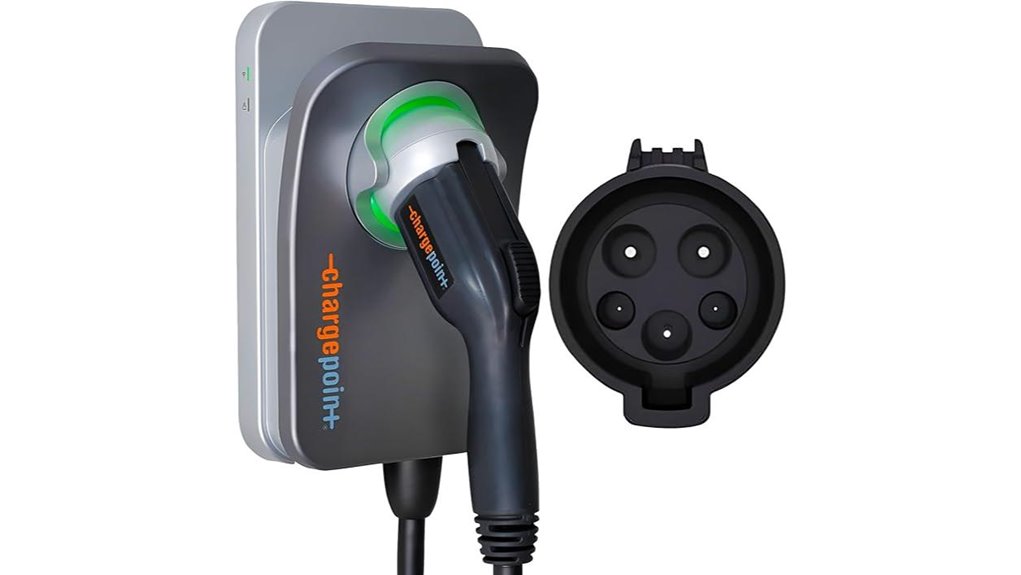
ChargePoint HomeFlex Level 2 EV Charger J1772

Looking for a reliable, fast‑charging solution that plugs straight into your 240‑V circuit? The ChargePoint HomeFlex Level 2 charger is a hardwired J1772 unit for home, commercial, or fleet use. It delivers 240 V AC at 50 A, drawing up to 80 A, so you’ll need a 20‑ or 80‑A circuit. Charging tops 45 mi/hr—nearly nine times faster than a 120‑V outlet—and its cable resists cold. The 7.06‑by‑11.19‑inch, 13.8‑lb unit is UL‑certified for indoor or outdoor installation. With Wi‑Fi, you control charging via the mobile app, view data, set reminders, and locate partner stations. A 3‑year warranty, 30‑day return, and 24/7 support give peace mind.
Best For: homeowners or fleet operators seeking a hardwired, fast Level 2 charging solution for J1772 vehicles.
Pros:
- Quick 45 mi/hr charging speed, nearly nine times faster than a 120‑V outlet.
- Rugged cold‑resistant cable and UL‑certified design for both indoor/outdoor use.
- Wi‑Fi connectivity and mobile app integration for remote control, reminders, and charging data.
Cons:
- Requires a dedicated 20‑ or 80‑A circuit and professional hardwiring.
- No built‑in smart panel or solar compatibility without additional equipment.
- Wi‑Fi dependent app features need a reliable home network connection.
https://www.amazon.com/dp/B0C6YMS4KH
EVIQO Level 2 EV Charger 40-48A WiFi

If you’re an EV driver who needs a fast, Wi‑Fi‑controlled charger that can deliver up to 11.5 kW, the EVIQO Level‑2’s 40‑48 A output makes it the smart choice. It runs on a 240 V hardwired feed, providing a 25‑ft cable and 40‑lb extension. A stainless‑steel J1772 connector powers all North American EVs and, with a Tesla adapter, Tesla models. The companion app controls start/stop, sets 6‑48 A, schedules off‑peak charging, and tracks consumption daily usage. Firmware updates come OTA, while a quick‑reset button offers instant fixes. IP66, NEMA‑4 housing resists rain, heat, and dust, and a 60‑A circuit guarantees safe 48 A operation.
Best For: Urban commuters who want a reliable, Wi‑Fi‑enabled Level‑2 charger for fast overnight charging with flexible cost management.
Pros:
- 11.5 kW output with up to 48 A for quick charging.
- Smart app control, OTA updates, and energy‑usage tracking for cost‑efficient operation.
- Durable IP66/NEMA‑4 enclosure and 60‑A circuit support for safe, weather‑proof performance.
Cons:
- Requires a licensed electrician and a dedicated 60‑A circuit, adding installation cost.
- Tesla adapter needed for Tesla vehicles, not supplied with the unit.
- Heavy (20.2 lb) and bulky stainless‑steel plug limits portability.
https://www.amazon.com/dp/B0D1XLRC5D
Tesla Wall Connector Level 2 EV Charger

The Tesla Wall Connector delivers the fastest Level 2 charging for Tesla owners, putting up to 11.5 kW onto the grid when paired with a 48 A breaker. It works with every Model S, 3, X, Y and offers 24 ft of cable for easy reach. You can set amperage from 12 A to 48 A in four‑amp steps, ensuring a match with your home’s limits. The unit’s Wi‑Fi lets you update firmware and monitor status remotely, while its power‑share feature allows up to six chargers to link and charge simultaneously. Certified by UL, CE, CEC, FCC, and IEC, it’s a reliable addition to any regular garage.
Best For: Tesla owners looking for fast, configurable home Level 2 charging with Wi‑Fi and power‑share capabilities.
Pros:
- Delivers up to 11.5 kW power (48 A) for quick recharge.
- Adjustable amperage in 4 A steps to match any home circuit size.
- Built‑in Wi‑Fi for firmware updates, remote monitoring, and power‑share with multiple units.
Cons:
- Requires a dedicated 240 V circuit and a breaker up to 48 A.
- Installation must be performed by a licensed electrician.
- Higher upfront cost compared to generic Level 2 chargers.
https://www.amazon.com/dp/B0BWSK35WH
Level 1/2 EV Charger 110-240V 25ft

This versatile charger, with its 110‑240 V range and 8‑16 A adjustable output, lets you tap any standard outlet for charging—ideal for drivers who need both Level‑1 convenience and Level‑2 power without an installation. It delivers up to 3.68 kW at 240 V, covering 9–12 miles per hour—sufficient for most daily commutes. A 2.8″ touch display shows voltage, current, and power, while a programmable 1–12 h timer helps you capitalize on efficient off‑peak rates. Safety is built in, with over‑heat, over‑voltage, and over‑current protection, FCC/CE certification and IP65‑rated housing. The 25‑ft cable lets you plug into NEMA 5‑15 for Level‑1 or NEMA 6‑20 for Level‑2.
Best For: drivers who need flexible Level‑1/Level‑2 charging without a hardwired installation.
Pros:
- Versatile 110‑240 V dual‑mode operation with adjustable 8‑16 A output.
- Compact, weather‑sealed IP65 housing with a touch‑screen display for real‑time monitoring.
- 25‑ft cable and plug‑in‑ready NEMA connectors eliminate the need for installation work.
Cons:
- Maximum 3.68 kW limits quick charging compared to fixed Level‑2 units.
- Requires separate 240 V outlet for Level‑2 mode, which may not be available in all homes.
- No smart‑home integration or app connectivity—manual timer and button control only.
https://www.amazon.com/dp/B0FXF6WVHH
bokman Level 2+1 EV Charger 20ft NEMA Adapter

You’ll appreciate the charger’s lightweight housing paired with a 20‑foot cable, letting you plug into a standard outlet while still traveling far enough to reach most parking spots. The kit comes ready with a carry bag, cable holder, microfiber towel, and a fixed NEMA 6‑20 plug for 240 V plus a NEMA 5‑15 adapter for 120 V. Adjusting current from 6 A up to 16 A gives you Level 1 and Level 2 options, while a mechanical 1‑to‑12‑hour timer keeps it running only when you need it. IP65 protection, fire‑resistant build, and drop‑rated safety shields you against heat, voltage spikes, and accidental drops. Portable power meets safety.
Best For: hobbyist EV drivers who need a portable, plug‑in charger for occasional Level 1 or Level 2 charging at home or in the office, without a Wi‑Fi or app integration.
Pros:
- Ultra‑light 9.4 lb chassis and 20‑ft cable make it highly portable and easy to store.
- Mechanical 1‑to‑12‑hour timer allows scheduled charging without a smart app.
- Dual NEMA adapters (6‑20 / 5‑15) and 6 – 16 A selection give flexible Level 1/Level 2 compatibility.
Cons:
- No built‑in Wi‑Fi or app connectivity for remote monitoring or scheduling.
- Requires a dedicated 240 V outlet for Level 2; sub‑optimal if only a 120 V outlet is available.
- Mechanical timer may be less precise and harder to set than digital alternatives.
https://www.amazon.com/dp/B0FHWJYY21
Level 2 WiFi EV Charger 32A NEMA 14-50P

If you’re looking for an at‑home EV charger that can cut your wait time to a fraction of a Level 1 charge, this Level 2 32 A unit is the pick. It delivers up to 7.68 kWh per session and lets you dial currents between 16 and 32 A, fitting on 20‑to‑40 A circuits. The 25‑ft military‑grade cable stays dropless and runs IP66, so you avoid sun and rain. Built‑in Wi‑Fi and Bluetooth let the companion app set timers, view real‑time stats, and send full‑charge alerts. A single LED screen shows voltage, amperage, and speed instantly. With factory reset via the charger, maintenance stays hassle‑free, and the 3‑year warranty covers all standard North American EVs. Connect it via a NEMA 14‑50 plug and enjoy quick, smart, and safe charging—no extra GFCI needed for today.
Best For: Home EV owners who want fast, app‑controlled charging on a 20‑to‑40 A circuit without the need for additional GFCI protection.
Pros:
- 32 A output delivers up to 7.68 kWh per session, cutting charging time by more than half compared to Level 1.
- Built‑in Wi‑Fi and Bluetooth let you set timers, view real‑time stats, and receive full‑charge notifications right from the companion app.
- 25 ft military‑grade cable with IP66 rating keeps it dropless and weather‑tough, ideal for outdoor or exposed installations.
Cons:
- Requires a dedicated 20‑to‑40 A circuit; smaller circuits will restrict current to 16 A.
- Current can only be set between 16 A and 32 A, limiting flexibility for some use cases.
- No integrated NEMA 5‑15 P adapter, so Level 1 110‑V charging is not natively supported.
https://www.amazon.com/dp/B0CG8D445Q
Grizzl-E Classic Level 2 240V 40A EV Charger

For electric‑vehicle owners who need a fast charger that plugs straight into any standard 14‑50R outlet, the Grizzl‑E Classic Level 2 240 V/40 A EV charger delivers the power you demand. UL‑certified and rebate‑eligible, it plugs into a 14‑50R without tripping breakers. The 24‑ft cable lets you park inside or at a campsite. Set 40 A, 32 A, 24 A, or 16 A for 28–12 miles per hour. GFCI and over‑current protections keep safe. Its NEMA‑4, IP67 case works indoors or outdoors, cold. 16.6 lb, the charger rolls and United Chargers backs it. Its 12‑year limited warranty and 3‑year parts guarantee give peace of mind, outage coverage.
Best For: electric‑vehicle owners who want a fast, portable Level 2 charger that plugs directly into a standard 14‑50R outlet without needing a hardwire installation.
Pros:
- Adjustable amperage (16 A–40 A) lets you tailor charging speed to your vehicle and breaker size.
- Built‑in GFCI, over‑current, and voltage protections provide safety for indoor‑outdoor use.
- 24‑ft premium cable and lightweight construction (16.6 lb) make it highly portable for home, camping, or work sites.
Cons:
- Requires a dedicated 14‑50R circuit; not suitable for locations without that outlet.
- No wireless or app connectivity for remote monitoring or scheduling.
- The 40‑A output may be overkill for smaller vehicles and can be expensive to install without a reinforcing breaker.
https://www.amazon.com/dp/B082LMVSLY
Autel Home Smart Level 2 50Amp EV Charger

When you need to charge your EV fast and reliably, the Autel Home Smart Level 2 50 Amp charger delivers 12 kW of power—about 37 miles of range per hour—alongside Bluetooth, Wi‑Fi, and Ethernet controls that’ll let you schedule sessions, monitor drive‑by‑app, and update firmware without leaving your home. Its 25‑foot cable crunches through harsh weather, rated down to –40 °C, making it perfect for garages or outdoor use. With CSA and NEMA‑Type 4 protection, it guards against fire, over‑current, and temperature spikes, keeping your home safe. Mount it on a wall, and the app tracks, optimizes off‑peak charging, and delivers daily OTA updates.
Best For: owners of electric vehicles who need a fast, reliable, and smart home charging solution with robust safety features for indoor or outdoor use.
Pros:
- 12 kW high‑power output delivers roughly 37 miles of range per hour, ideal for quick charging.
- Built‑in Bluetooth, Wi‑Fi, and Ethernet give flexible connectivity, remote control, and OTA firmware updates.
- CSA‑certified, NEMA‑Type 4 enclosure plus fire‑resistance, over‑current, and temperature safeguards keep homes safe.
Cons:
- 25‑foot cable can be too short for some garage configurations, potentially requiring an extension.
- Relies on the proprietary Autel Charge app; limited compatibility with other home automation ecosystems.
- Premium price point may be steep for budget‑conscious buyers compared to lower‑power chargers.
https://www.amazon.com/dp/B0BDLQMR51
EMPORIA WiFi Level 2 EV Charger (48A)

The EMPORIA WiFi Level 2 charger, paired with a 48 A hard‑wired connection, delivers 46 miles of range every hour—over nine times faster than a standard 120‑V outlet.
Choose your 40‑A NEMA 14‑50P model for a wall‑mounted setup; convert it to a 48‑A hardwired line to boost power. The unit is UL‑listed, ENERGY STAR certified, and satisfies NEC 625, SAE J1772, UL 817, UL 991, UL 2231, UL 2251, and UL 2594. Its 2.4 GHz Wi‑Fi gives real‑time usage data, a scheduler, and rate‑optimization via phone app. With a 25‑ft cable, IP‑66 enclosure, 12.9 × 9 × 3.5‑in footprint, and 12.17‑lb weight, it fits any driveway. Install professional to guarantee safety and reliability.
Best For: EV owners looking for rapid, Wi‑Fi‑enabled charging at home.
Pros:
- 46 miles of range per hour via 48 A hard‑wired connection
- Wi‑Fi connectivity and app‑based scheduling for rate optimization
- UL‑listed and ENERGY STAR certified for safety and compliance
Cons:
- Requires professional installation for hard‑wired setup
- Unit’s size and weight may limit placement in tight spaces
- Fixed 25‑ft cable can be restrictive for longer installations
https://www.amazon.com/dp/B09BP1GM76
MACH 1 48A Level 2 EV Charger

If you own an EV that thrives on high‑power charging—especially for long commutes or a small fleet—the Mach 1 48A Level 2 charger is the smart pick. This ApexCharger model wall‑mounts easily, features a 30‑ft cable, LED display, and built‑in OBC. It delivers 240 V at 48 A, ideal for fast, efficient charging. Rugged outdoor‑grade housing, anti‑theft bolt, and a cable holder keep the unit safe. You’ll also get a Pro 1 NACS adapter so Tesla cars plug in, plus Wi‑Fi/Bluetooth connectivity for remote monitoring. Warranty spans five years and support is nonstop, and you can rest easy knowing your vehicles charge reliably.
Best For: owners of high‑power EVs or small fleets needing fast, reliable Level 2 charging with versatile connectivity and rugged outdoor durability.
Pros:
- 48 A output delivers 11.5 kW of fast charging on a standard 240 V circuit.
- Integrated OBC, Wi‑Fi/Bluetooth, and NACS adapter enable remote monitoring and universal adapter compatibility.
- Weather‑proof enclosure, anti‑theft bolt, and cable holder protect the unit in harsh conditions.
Cons:
- Single‑port design limits simultaneous charging for multiple vehicles.
- Requires hard‑wiring and a 50 A breaker, which increases installation complexity.
- No built‑in solar or battery support, relying solely on grid power.
https://www.amazon.com/dp/B0CN7D16QS
Junsun 32Amp Level 1&2 Portable EV Charger

Need a charger that can snap from a fast 7 kW boost on the highway to a gentle 1.7 kW overnight mode? With a 32‑amp output, the Junsun JS‑US‑DCDQ326TM‑D plugs into both NEMA 5‑15 for Level 1 and NEMA 14‑50 for Level 2, letting you charge on 110 V or 240 V. You can tweak the current from 6 A up to 32 A, so you finish a night’s charge faster or keep it gentle. Its LCD shows voltage, current, battery percentage, and time left, while LEDs warn of leaks or voltage issues. The 20‑ft cable lets you reach the garage or driveway, and the travel bag keeps it handy. One‑year warranty covers non‑misuse. Its compact design fits in your trunk, making travel don’t cost you extra space today.
Best For: EV drivers who want a single portable charger that delivers fast Level 2 power on the road and gentle Level 1 overnight charging at home.
Pros:
- Dual‑level capability (110 V/240 V) with adjustable current up to 32 A for flexible charging options.
- 20‑ft cable and compact travel bag make it easy to use in garages, driveways, or while traveling.
- Built‑in LCD and LED alerts give real‑time monitoring and instant safety notifications.
Cons:
- 1‑year warranty is modest compared to some competitors.
- The 32 A output is limited by a single NEMA 14‑50 cord, so simultaneous multiple‑vehicle charging isn’t possible.
- Cable length and weight can be cumbersome for long trips or stiff charging setups.
https://www.amazon.com/dp/B0F58YYLL3
ELEGRP Portable 16A Level 1/2 J1772 Charger

For anyone who needs to charge an EV outside a home outlet, the ELEGRP Portable 16A Level 1/2 J1772 Charger delivers 16 A—up to 1920 W—via a 25‑ft cable, enabling full charging on the go. Its built‑in PBE protection guards against surge, leakage, and overload, while the LRC differential keeps the unit cooler and maintains throughput. Plug it into a NEMA 6‑20 for Level 2, and you’ll gain about 3.84 kWh hourly—roughly 11–14 miles—plus Level 1 via any 120 V adapter, giving flexible charging wherever you park. Its 25‑ft cable stays IP67‑rated, survives temperatures from –21 °F to 121 °F, and passes 2,000 bending tests for reliability.
Best For: outdoor EV owners who need a reliable, high‑power Level 2 charger that can be hauled to work sites or travel locations with limited access to home outlets.
Pros:
- 16 A / 1920 W output delivers up to 3.84 kWh per hour (~11–14 miles) on a 25‑ft cable.
- IP67 rating and wide temperature range (–21 °F to 121 °F) plus 2,000 bending tests ensure durability in harsh weather.
- Built‑in PBE protection and LRC differential keep the unit safe and cool during operation.
Cons:
- Requires a NEMA 6‑20 receptacle for Level 2; not plug‑and‑play with a standard 120 V outlet.
- 2‑year warranty may limit repair options for misuse or environmental damage.
- Weight (~7 lb) and size (14.3 × 13.3 × 4.7 in) make it bulkier than some portable chargers.
https://www.amazon.com/dp/B0DY7TT3VD
Level 2 Portable 40Amp EV Charger

This Level‑2 portable 40‑Amp charger delivers 9.6 kW of power, making it ideal for drivers who want fast, on‑the‑go charging.
You’ll appreciate its 240 V, 40 A capability, giving you 8× the speed of a Level 1 unit.
Adjustable currents—from 10 A up to 40 A—let you match your battery and power source.
Its 2.4″ TFT display and LED indicators show voltage, current, power, kWh, and time remaining.
The delay‑start feature flexes your schedule—set a 1‑12 h timer with one touch.
Safety’s baked in: a smart chip shields against over‑current, voltage spikes, overheating, and short circuits.
IP66 protection and a 25‑ft cable let you charge anywhere.
Best For: drivers who need fast, on‑the‑go charging for 240 V EVs and can accommodate a NEMA 14‑50 plug (e.g., commuters or road‑trippers).
Pros:
- 9.6 kW output for rapid charging and adjustable currents adapt to battery/utility limits.
- Intuitive 2.4″ TFT display + LED indicators and delay‑start timer for easy monitoring and scheduling.
- Robust IP66 rating, 25‑ft cable, and integrated over‑current/over‑temperature protections ensure safety and portability.
Cons:
- Requires a Tesla adapter (not supplied), restricting use for Tesla owners without one.
- Cable length is only 25 ft, which may be insufficient for some residential setups.
- Relatively heavy (11.5 lb) and bulkier than smaller Level‑1 or stainless‑steel portable chargers.
https://www.amazon.com/dp/B0F1844VRF
48A Level 2 J1772 Wall Charger Non‑Tesla

Want to cut charging time without a Tesla? This 48 A Wall Charger delivers 11.5 kW, adding roughly 46 mi of range per hour. Adjustable in 1 A steps up to 48 A, it’s fast, safe, and even auto‑stops when the sensor reads above 221 °F. With Wi‑Fi, RFID, and an app, you schedule sessions, monitor energy use, and receive OTA updates. Mount it with a NEMA 14‑50P, 60 A breaker, and built‑in GFCI. Two units share a breaker and can connect through a NACS adapter for Teslas. The 3‑year warranty and 3‑hour support windows give peace of mind, and seamless integration with your existing network today.
Best For: EV owners who want a fast, app‑controlled wall charger that can safely share a single circuit and is compatible with multiple makes, including Tesla via adapter.
Pros:
- 48 A / 11.5 kW output delivers 46 mi of range per hour, making charging 7–9× faster than Level 1.
- Smart Wi‑Fi (2.4 GHz), RFID, OTA firmware, and scheduling through the app for convenient, energy‑efficient use.
- Built‑in GFCI, dual‑sensor safety, and power‑sharing design allow two chargers on one 60 A breaker safely.
Cons:
- Requires a licensed electrician and a 60 A breaker; not ideal for simple DIY installations.
- Wi‑Fi is limited to 2.4 GHz only, and no Tesla adapter is included—Tesla owners need an external NACS adapter.
- The charger is larger and heavier (13.45 lb cable) and has no lower‑power (≤3 kW) output options.
https://www.amazon.com/dp/B0FP886BVQ
VEVOR 16A Portable EV Charger 25 ft Cable

If you’re a commuter who often parks a yard from a power outlet, the VEVOR 16‑amp portable charger gives you a 25‑foot reach—plus an IP66‑rated, weather‑proof enclosure so rain or dust won’t kill your charging session. It plugs into 120‑V or 240‑V outlets via its NEMA 6‑20P connector, with an optional NEMA 5‑15 adapter. The 16 A output supports Level 1 or Level 2 charging, while LED indicators display status and safety alerts. An intelligent chip guards against surge, leakage, over‑voltage, overload, and overheating. At only 7.3 lb, it fits in its carrying bag for transport and setup. A 30‑day return guarantee backs your purchase.
Best For: commuters and EV owners who need a portable Level 1/2 charger with a 25‑ft reach and all‑weather protection for on‑the‑go charging.
Pros:
- 25‑ft cable gives ample reach across most driveways and garages.
- IP66 waterproof housing and 7.3 lb weight make it rugged and travel‑friendly.
- Intelligent safety chip plus LED indicators provide continuous protection and real‑time status.
Cons:
- 16 A output limits it to Level 1 or slow Level 2 charging.
- Requires a NEMA 6‑20P outlet (or adapter) which may not be as widely available.
- 30‑day return guarantee only; longer warranty options are limited.
https://www.amazon.com/dp/B0FL63CSLZ
Factors to Consider When Choosing an EV Charger
When you pick an EV charger, you’ll first want to know its charging speed—does it fill your battery fast enough for your daily commute? Next, check installation needs and connectivity options, so you can mount it easily and keep track of usage through Wi‑Fi or app integration. Finally, factor in the price and safety certifications, ensuring the unit stays affordable while meeting all regulatory standards.
Charging Speed
Because charging speed directly impacts how quickly you can get back on the road, grasping how a charger’s amperage translates to real‑world kW output is essential. A Level 2 unit running 240 V at 32 A produces about 7.68 kW, giving you roughly 35–40 miles of range per hour—enough for many daily commutes. Push the amperage up to 48 A and you hit 11.5 kW, adding around 45–50 miles in the same time, which is almost nine times faster than standard 120 V Level 1. Chargers rated 20–30 A sit between 4.8–7.2 kW, delivering 20–28 miles per hour and fitting moderate driving habits. Remember, though, that a 32 A charger won’t outpace your EV’s onboard limit if it tops out at 13 A. Therefore, choose an amperage close to your vehicle’s maximum to avoid wasted time.
Installation Requirements
Which factors should you weigh when picking an EV charger? Start with the electrical gauge: a hard‑wired Level 2 charger rated at 40 A demands 10 AWG copper and a dedicated 50 A breaker, leaving a 20 % margin when shared. For outdoor units, install a NEMA‑4 or IP66 enclosure within 6 ft of the nearest junction box per NEC 406.8. A 48 A charger using a 14‑50 receptacle requires 6 AWG neutral and ground and a four‑pin NEMA 14‑50P for a proper safety bond. Level 1 systems must run on a 15‑ or 20‑A circuit with cable under 25 ft to keep voltage drop under 3 % (NEC 110.14(A)). If your charger relies on Wi‑Fi, mount it within 150 ft of your router—or add an extender—to keep your app in sync and sidestep timing glitches, and monitor daily performance.
Connectivity Options
If you’re planning to connect your EV charger to the internet, picking the right connectivity type—Wi‑Fi, Bluetooth, or Ethernet—will dictate its reliability, control options, and security level. Wi‑Fi (2.4 GHz) lets you manage charging, view real‑time data, and get remote firmware updates through a dedicated app—but it demands a stable home network. Bluetooth offers quick local start/stop without internet, yet it lacks remote monitoring and OTA updates. Ethernet gives wired reliability, perfect for scheduled charging and secure firmware updates without wireless interference. Many chargers sync time via NTP, allowing on‑time schedules that match variable utility rates, independent of your device. Remote access can be protected by VPN or encrypted tunnels, keeping your charging data private while you monitor from abroad and enjoy peace of mind.
Cost Considerations
Choosing the right level of charging power can spin your budget, but the key is to weigh the cost against the savings you’ll rack up over time. Level 2 units range from a few hundred dollars for low‑current models to $800–$1200 for high‑current options, while a Level 1 charger costs $200–$400. Hardwired installs add $200–$500 for breaker upgrades, versus the $40–$80 of a plug‑in Level 1. Federal credits cover up to 30% of the purchase price and utilities often rebate $100–$200. High‑current chargers also allow off‑peak rates that trim monthly bills by 10–20%. Wi‑Fi models usually ship with a 3‑year warranty, cutting future maintenance costs. Factor in tax incentives that can shave additional dollars off the price and consider your driving habits to pick the right amperage.
Safety Certification
Because safety certification proves compliance with rigorous standards, you’ll trust the charger will protect you from electrical hazards. Look for UL 2231 or UL 991 to confirm the unit passed tests for over‑current protection, short‑circuit resilience, and isolation. Energy‑Star certification means the charger runs at 90 %+ efficiency, cutting heat output and fire risk. Weather‑proofing matters too—an IP66 or NEMA‑4 rating guarantees dust and water resistance for outdoor use. Built‑in GFCI stops power quickly if a ground fault occurs, keeping you safe during long sessions. Finally, FCC Part 15 or CE compliance shows the charger’s Wi‑Fi stays within electromagnetic limits, so it won’t jam your audio gear. These certifications let you drive with peace of mind. Stay informed, check documentation, and choose trusted brands for safety and peace.
Frequently Asked Questions
What Is the Typical Cost of Installing a Level 2 Charger?
The typical cost of installing a Level 2 charger ranges from $800 to $1,800, depending on wiring, permits, and amperage. If you already have a dedicated 240‑volt circuit, you’ll likely pay toward the lower end. New circuits, disconnect boxes, and local permitting add to the expense. Add a professional installer fee, and budget roughly $1,100 on average. This estimate excludes any custom mounts or cable upgrades. Check local codes carefully today.
How Long Is the Warranty on Most Level 2 Chargers?
Most Level 2 chargers come with a 2‑to 5‑year warranty, covering the charging unit itself. The installer’s labor typically gets a 1‑year guarantee. If you’re looking for longer peace of mind, you can often purchase extra coverage that extends up to 10 years. Pay close attention to coverage limits, as some plans exclude battery packs or cut coverage during marine usage. Always read the fine print before you buy today.
Do Level 2 Chargers Produce Audible Noise During Charging?
Back in the days of steam engines, you’d imagine a gentle thunk as the machine sprung to life. With level‑2 chargers, you’ll hear the soft hum of the inverter and, occasionally, a faint click or buzz—nothing like a roaring generator. Their noise stays well below office‑grade. If your charger’s housing is well‑sealed, you’ll hardly notice it, and you’ll regularly finish charging quietly. you’ll notice just a delicate hum everywhere nearby.
What Is the Maximum Safe Cable Length for Level 2 Charging?
The maximum safe cable length for Level 2 charging is typically 25 feet (about 7.5 m). If you stretch the cord longer, voltage drop and heat rise can lower efficiency and safety. Keep your charger near the outlet to stay within the 25‑foot limit. If you need more reach, consider a portable charger or a later‑stage installer who’ll swap a longer cable. Always follow your EV manufacturer’s guide for best performance every time.
Do EV Chargers Require FCC Certification?
Think of your charger as a radio station—if it wants to broadcast its power without disturbing other signals, it needs FCC clearance. Yes, most EV chargers must carry FCC certification, especially their wireless and data modules, because they emit radio frequency energy. The power supply kit itself often meets safety standards, but the entire unit still needs FCC compliance to operate legally before you plug in your home charger today.
Conclusion
Choosing the right charger is like picking a trusty compass for the electric road ahead. You’ll weigh power, price, and compatibility, then match it to your home setup or on‑the‑go lifestyle. Remember that future upgrades and convenience are as valuable as the current charge. By doing so, you’ll plug into peace of mind, power your journey, keep your EV ready whenever the road calls for smooth and green driving everywhere you go with confidence today.

Introducing Maria, our meticulous planner and talented visual storyteller. She has a knack for discovering those hidden gems, chic boutique spots, and charming little cafes that add a touch of elegance to every journey. With her keen eye for photography and her passion for travel, Michelle will transport you to the most enchanting corners of the world, inspiring you to explore new places, one picture-perfect destination at a time.