Tag: home renovation

Tankless Water Heater Essentials Every Home Needs

Choosing a tankless water heater gives you hot water, saves space, and cuts standby energy losses. A 240‑V 18 kW Rheem or 11 kW unit heats 4.4–2.6 GPM at 140 °F, while an EcoSmart 13 kW model offers smaller footprints and smart displays. A 110‑V portable unit fits tight spots but delivers only 0.3–0.5 GPM. For larger houses, consider Rinnai’s 199 k BTU dual‑fuel or a 27 kW Opti27 for high demand. Find the right match by comparing flow, voltage, and warranties—discover more step.

Key Takeaways

  • Determine required hot‑water flow by calculating peak gallons‑per‑minute (GPM) needed for all fixtures; choose a unit with 1.3 × 2.5 × … GPM rating to cover peak flow.
  • Match unit size to home space; units like the EcoSmart ECO 11 use a small footprint (≈ 11.5 × 8 in.) and fit in tight cabinets, while larger models (e.g., Rinnai RX199iN) need more room.
  • Select the correct voltage and wiring; most domestic units run on 240 V (Rheem, EcoSmart), but 110 V units exist—ensure a dedicated circuit meets the unit’s amperage.
  • Use vent‑free, self‑modulating units (99.8 % eff.) for easier installation and lower energy costs; verify local codes for venting requirements.
  • Choose a unit with a long warranty and proven durability (e.g., 60‑month warranty on Rheem or lifetime coverage on EcoSmart electronics) to minimize long‑term maintenance.

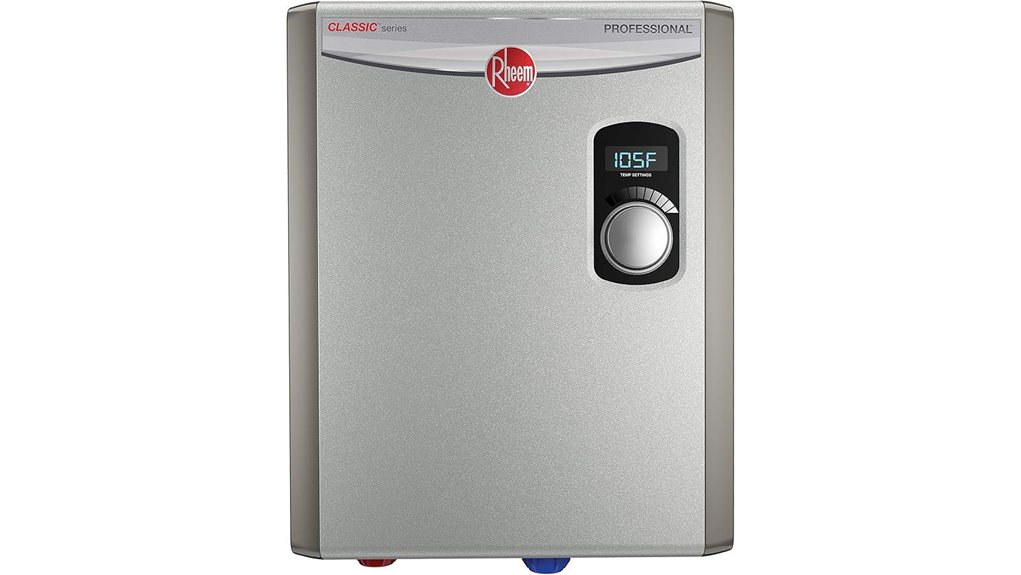
Rheem 18kW 240V Tankless Electric Water Heater, Gray

rheem 18kw tankless heater

If you need a hot‑water solution that keeps your entire house cozy without taking up precious space, the Rheem RTEX‑18 delivers 18 kW of instant heat in a compact package.

It weighs 14.78 lb and measures 14.5 in W × 18.25 in H × 18.25 in D. A 240 V AC source powers a copper‑immersed heater, delivering 4.4 GPM fluid at 140 °F. The LED thermostat reads ±1 °C, giving control. Self‑modulating logic cuts consumption by up to 50 %, raising efficiency to 99.8 %. Installation uses 3/4‑inch threaded inlet/outlet; doesn’t need venting. Warranty covers 60 months; customer service offers setup, parts, troubleshooting support today.

Best For: homeowners looking for a compact, high‑efficiency tankless water heater that can supply whole‑house hot water.

Pros:

  • 18 kW instant heating delivers 4.4 GPM at 140 °F, covering most residential demands.
  • 99.8 % efficiency with self‑modulating logic can cut energy bills by up to 50 %.
  • Space‑saving, vent‑free design is easy to install under‑sink or on a wall.

Cons:

  • Requires a dedicated 240 V AC circuit; not suitable for homes without a compatible outlet.
  • 4.4 GPM output may be insufficient for simultaneous multi‑point usage in larger households.
  • While ventless, still requires adequate spacing and proper grounding per code.

https://www.amazon.com/dp/B01MR7Z39V

Rheem 11kW 240V Tankless Electric Water Heater

rheem 240v tankless 11kw

When you need hot water in a tight kitchen nook or bathroom, the Rheem RTEX‑11 tankless electric unit fits the bill: it’s a stainless‑steel heater that’s 90 % smaller than a traditional tank, delivers 11 kW of heat at 2.68 GPM, and only draws power while water is flowing—thanks to its self‑modulating controller that keeps your set temperature steady. Turn it on with the ON/OFF dial and read the temperature on the display. The 99.8 % efficient unit draws 240 V AC, supplies 2.68 GPM, and its stainless‑steel build resists corrosion. It mounts the wall with ½‑inch NPT fittings, no venting, and sits at 3.2 kg.

Best For: small kitchen sinks, bathrooms, or other tight spaces where a compact, efficient, on‑demand heater is needed without venting or tank bulk.

Pros:

  • Compact, 90 % smaller than tank models, ideal for tight installs.
  • 99.8 % efficiency and self‑modulating control keep water at the set temperature.
  • Stainless‑steel construction resists corrosion and supports a long lifespan.

Cons:

  • Requires a 240 V AC supply and a dedicated, wall‑mounted installation.
  • Limited flow rate (2.68 GPM), so only one or two fixtures can run simultaneously.
  • Higher upfront cost compared to traditional tank heaters, though offset by energy savings.

https://www.amazon.com/dp/B01N35V1HH

EcoSmart ECO 11 13KW Tankless Water Heater

ecosmart eco 13kw tankless

The EcoSmart ECO 11’s compact 13 kW design and patented self‑modulating control make it the hot‑water solution for homeowners who need space‑savvy, efficient water on demand. It plugs into a 240 V supply and draws just 54 A, keeping your circuit load reasonable. With a 13 kW output, it delivers 1.3–3.1 GPM depending on inlet temperature, so a single shower runs comfortably, while a household that does two warm showers or multiple sinks can also benefit in moderate climates. Set the temperature from 80 °F to 140 °F in one‑degree steps using its bright LED display today. Its lifetime warranty covers electronics, exchanger, and element—no labor.

Best For: homeowners needing a compact, high‑efficiency tankless heater for single showers or small households that can run a 240 V circuit.

Pros:

  • 99.8 % thermal efficiency for lower running costs.
  • Small footprint (11.5×8×3.75 in.) fits tight spaces or point‑of‑use locations.
  • Lifetime warranty on the electronics, exchanger, and element (no labor).

Cons:

  • Requires a dedicated 240 V, 54 A circuit—more costly to install.
  • Limited flow rate (1.3–3.1 GPM) may not suit simultaneous multi‑fixture use.
  • Higher upfront price than traditional tank heaters.

https://www.amazon.com/dp/B001LZRF9M

110V 3000W Instant Tankless Electric Water Heater

tankless 110v 3000w heater

Compact and wall‑mounted, this 3000 W, 110‑V electric water heater delivers instant hot water, making it the perfect choice for renters, tiny apartments, and RV owners who need space‑saving convenience. Its stainless‑steel heat chamber and ABS housing boost efficiency to 98 %, while the LED digital display lets you check temperature in Fahrenheit or Celsius on the fly. You’ll get a quick 82 °F rise at 0.3 GPM and a 131 °F boost at 0.5 GPM—perfect for a quick shower or a batch of dishes. Install it by screwing through pre‑made holes; connect 2.5 mm² wires, a 30 A circuit and a 32 A trip switch for use.

Best For: renters, tiny apartment dwellers, and RV owners who need compact, instant hot water without a bulky tank.

Pros:

  • Compact, wall‑mounted design saves space and is ideal for small or temporary setups.
  • Immediate hot water delivery with quick temperature rise for efficient dishwashing or brief showers.
  • 98 % thermal efficiency and LED digital display provide accurate, energy‑saving operation.

Cons:

  • Requires a dedicated 30 A circuit and 32 A trip switch, limiting installation flexibility.
  • Cannot be installed horizontally, restricting mounting options in some spaces.
  • Not suitable for full showers or high‑flow applications (max 0.5 GPM).

https://www.amazon.com/dp/B0FTCMVRY3

Rinnai RX199iN 199k BTU Tankless Heater

rinnai 199k btu tankless

Need a tankless heater that keeps the water flowing even while the whole household is using it? The Rinnai RX199iN delivers 199,000 BTU, letting you run up to seven fixtures at 11.1 GPM. With a max temp of 140 °F and 150 psi pressure, it works reliably on natural gas or propane thanks to Smart Sense. Its compact 18.5 × 30.1‑inch silver unit weighs 55 lb, mounting only on walls. The quick‑flush function keeps it tank‑free, and optional Wi‑Fi ControlR lets you monitor remotely. Install with a Rinnai PRO technician; the unit enjoys a UEF of .98, Energy‑Star rated, and a 1‑year warranty and come with included accessories.

Best For: households that need reliable, simultaneous hot water at up to seven fixtures or experienced multilevel heating systems.

Pros:

  • Energy‑Star rated with a 0.98 UEF for low energy consumption and homeowner savings
  • Dual‑fuel (natural gas or propane) and Smart Sense control for seamless fuel switching
  • Quick‑Flush and optional Wi‑Fi ControlR make maintenance easy and enable remote monitoring

Cons:

  • Wall‑mounted only, so limited placement options
  • 55‑lb unit requires a sturdy support bracket and some wall‑strengthage
  • 1‑year limited warranty is relatively short compared to some competitors

https://www.amazon.com/dp/B0CM4L8VKC

SIVUATEK 14kW Tankless Water Heater

sivuatek 14kw tankless heater

If you’re after instant hot water that’s reliable and efficient, the SIVUATEK V7B‑140B gives you 14 kW of power and 2.3 gpm right where you need it. Its compact shoebox design mounts easily next to showers or washers, fitting standard 24‑inch spaces. Operating at 240 V, it delivers up to 110 °F water, while a self‑modulating control keeps temperature steady by adjusting output to flow rate. The digital touchscreen shows real‑time status, and built‑in safety—overheat protection, leak detection, auto‑shutdown—keeps you protected. At 98 % efficiency, it cuts energy use, and the 12‑month warranty adds peace of mind. for homeowners and utility savings.

Best For: homeowners who need instant, on‑demand hot water for showers, baths, or laundry in a compact space.

Pros:

  • 14 kW power delivers 2.3 GPM hot water on demand with a 98 % efficiency rating, cutting energy use.
  • Digital touchscreen offers real‑time status and user‑friendly controls.
  • Built‑in safety features (overheat protection, leak detection, auto‑shutdown) and a 12‑month warranty provide peace of mind.

Cons:

  • Requires a dedicated 240 V circuit and may need electrical upgrades in older homes.
  • 110 °F maximum temperature may be insufficient for some large‑pot or kitchen applications.
  • Limited to about 2.3 GPM, which could be low for simultaneous multi‑tap use.

https://www.amazon.com/dp/B09CYFH5H7

Titan Electric Tankless Water Heater

titan electric tankless heater

Your home or small commercial space that demands continuous, instant hot water during peak usage looks to the Titan N‑120 tankless heater.

At 11,800 W and 54 amps, it powers high‑end usage.

Its 99.5 % efficiency cuts running costs.

Dual heating chambers deliver on‑demand flow without sacrificing temperature efficiently.

The white titanium housing is compact: 9.6 in wide, 12 in tall, 2.75 in deep, wall‑mounted.

Plug it into a 220‑V corded circuit; no special setup needed.

A 30‑day return and a separate warranty give you peace of mind, simply today.

Titan by Niagara Industries guarantees reliability; model N‑120 is easy to spot on UPC and ASIN.

Best For: households or small commercial spaces that need instant, continuous hot water during peak usage and a compact, high‑efficiency solution.

Pros:

  • Extremely high efficiency (99.5%) reducing running costs.
  • Dual heating chambers deliver steady flow without temperature drops.
  • Compact, titanium construction fits wall‑mounted installations.

Cons:

  • Requires a 220 V corded circuit, limiting compatibility with standard 120 V outlets.
  • Highest‑rated draw (54 A) demands a dedicated high‑voltage circuit.
  • No built‑in flow meter or temperature control display for user adjustments.

https://www.amazon.com/dp/B003XRC2IA

Portable 16L Tankless Propane Heater with Digital Display

portable digital propane heater

Because its 16‑liter tankless design paired with a digital display keeps hot water at hand wherever propane is available, the heater is the best choice for RV owners, campers, and anyone needing a quick, electric‑free backup. Hook it to the 5‑ft regulator, and it delivers 4.21 GPM at 167 °F, with a 68 000 BTU/h heat rate. A triple‑layer safety guard protects against flame failures, overheating, and freezing, while the digital display tracks real‑time data. The lightweight alloy body, 5‑spray head, and 59‑inch stainless hose make setup effortless. A 30‑day return and 3‑month warranty cover defects in case of any issues for you.

Best For: RV owners, campers, and anyone needing a portable, electric‑free hot water solution backed by a propane supply.

Pros:

  • 16‑liter tankless design delivers 4.21 GPM at 167 °F with 68 000 BTU/h heat output.
  • Triple‑layer safety guard and digital display for real‑time operation and peace of mind.
  • Lightweight alloy body, 59‑inch stainless hose, and 5‑spray head simplify setup without tools.

Cons:

  • Requires propane supply and a separate 2‑cell battery (optional).
  • 30‑day return period may not cover all usage scenarios for all buyers.
  • No built‑in leak detection or automatic shutoff for prolonged use.

https://www.amazon.com/dp/B0FQ55S4MC

FOGATTI Indoor 170,000 BTU Tankless Water Heater

indoor fogatti tankless heater

For homeowners who need a dependable, high‑flow solution that can power several showers or tubs at once, the FOGATTI InstaGas Comfort 170S offers 170 000 BTU and 7.5 GPM right out of the box—perfect for 3‑to‑5 simultaneous outlets in a single, compact wall‑mounted package.

It runs on natural gas, delivering 170 kBTU with a four‑stage burner that limits temp swings to ±1 °F. At 7.5 GPM it handles 3–5 outlets, and its 25 × 16.3 × 7.3‑inch size keeps it wall‑mounted. The unit uses 120 V AC, accepts 15–150 PSI, and features copper heat exchanger plus 304 stainless steel burner. CSA‑certified safety, an anti‑freeze drain, and a two‑year full‑unit warranty give peace of mind.

Best For: homeowners who need a high‑flow, wall‑mounted water heater capable of powering 3–5 showers or tubs simultaneously.

Pros:

  • 170,000 BTU output provides 7.5 GPM for multiple outlets at once
  • Four‑stage combustion keeps temperature swings within ±1 °F
  • CSA‑certified safety, anti‑freeze drain, and 2‑year full‑unit warranty

Cons:

  • Requires 120 V AC power, may need electrical upgrades in older homes
  • Installation must follow gas, pressure, and venting specifications precisely
  • Performance limited to elevations below 2,000 ft, reducing effectiveness at high altitudes

https://www.amazon.com/dp/B0DQ4KM8KZ

ORBEK 14kW Tankless Heater, 240V LED Display

orbek 14kw tankless heater

If you’re hunting for a compact solution that delivers instant hot water, the ORBEK 14 kW tankless heater is the answer. It runs on a 240 V/60 A breaker, uses 6 AWG wire, and packs 14 kW output in a 14.2 H × 9.5 L × 3.1 W enclosure, cutting space by ~50 % compared to tanks. The LED digital display shows 86 °F–140 °F with ±1 °F stability, and 3.38 GPM lets you run 2–3 points at once. You’ll save about 60 % on electricity, get instant heat in 3 s, and enjoy ETL‑certified safety plus leak, dry‑heat, and flame‑resistance protection. Plus, it comes with a one‑year warranty and 24/7 customer support, so you’re covered against failures.

Best For: homeowners who need a space‑saving instant hot water solution that delivers reliable performance, energy savings, and robust safety features.

Pros:

  • Compact design cuts space usage by ~50% compared to tank heaters.
  • Instant hot water in 3 s with 3.38 GPM flow for multiple points.
  • ETL‑certified safety, built‑in leak & dry‑heat protection, 1‑year warranty.

Cons:

  • Requires a 240 V/60 A breaker and 6 AWG wiring—installation can be costly.
  • 14 kW output may not meet high demand in very large homes.
  • Initial purchase price higher than basic tank heaters.

https://www.amazon.com/dp/B0DW8XWXLG

8KW Electric 240V Tankless Water Heater

8kw 240v tankless heater

The WINTEMP YQ‑WN8K, an 8 kW, 240‑volt tankless water heater, delivers instant 140 °F water at 1.9 gal min⁻¹, making it the perfect choice for homeowners who want continuous hot water without the bulk of a traditional tank. It runs on a 240‑volt AC supply, drawing a maximum of 33 A from a single 40‑amp DP breaker and 10 AWG wire, yet its compact 9.7″ × 14″ × 3.4″ mountable unit saves space and eliminates bulky tanks. With 1.9 gal/min flow, heater reaches 140 °F, while its self‑regulating design cuts power when flow drops, saving 99 % energy and lifespan. Enjoy peace of mind with ETL® safety certification and a 2‑year return/exchange program.

Best For: homeowners who want instant, continuous hot water without a bulky tank and have a 240‑V circuit available.

Pros:

  • Compact 9.7″ × 14″ × 3.4″ unit saves space.
  • Self‑regulating design cuts power use up to 99 % when flow drops.
  • ETL® certified with 2‑year return/exchange support.

Cons:

  • Requires a dedicated 240‑V, 40‑A circuit and 10‑AWG wiring.
  • Higher upfront cost than conventional tank heaters.
  • Flow is limited to 1.9 gal/min, which may not satisfy multiple simultaneous hot‑water draws.

https://www.amazon.com/dp/B0DP99LNX5

Novieex Tankless Natural Gas Water Heater

novieex tankless gas heater

Looking for instant hot water on demand while slashing energy bills? You’ll find the NOVIEEX RS‑16 delivers 100 000 BTU/hr, topping 4.3 GPM and keeping temperatures between 95 °F and 149 °F. Its burner cuts standby heat, so you only pay for water you use. The thermostat stops fluctuations, while a LED touchscreen offers instant settings. A built‑in safety suite—gas‑leak detection, overheat, dry‑fire, flame‑failure, and anti‑freeze—protects your home. Wall‑mounted units save half the space of tank heaters, fitting basements or closets. Though you’ll need a licensed installer, the unit’s wall‑mounted, pearl‑grey finish blends and the LED display keeps you informed in real time everywhere.

Best For: families who need instant, constant hot water and want a space‑saving, energy‑efficient solution that balances comfort with cost savings.

Pros:

  • 100 000 BTU/hr burner provides ample flow for simultaneous use of multiple fixtures.
  • Integrated safety suite (gas leak, overheat, dry‑fire, flame‑failure, anti‑freeze) ensures safe operation.
  • Wall‑mounted, pearl‑grey design conserves space and blends seamlessly with home décor.

Cons:

  • Requires a licensed technician and natural‑gas line; installation can be costly.
  • Limited to indoor usage and needs proper venting and clearances for exhaust.
  • Initial purchase price higher than standard tank heaters, offset only by long‑term savings.

https://www.amazon.com/dp/B0FN7ZH4JF

Opti27 27kW Tankless Water Heater, 25-Year Warranty

opti27 27kw tankless 25 year

With 27 kW of power and a 4.5 gal/min flow rate, the Opti27 can keep all the faucets in a medium‑sized household running hot at the same time.

Mounted on your wall, its white design blends into kitchen. Powered at 240 V, it delivers 140 °F heat with a 150 psi pressure threshold, staying within safety limits. The patented ultrasonic flow tech secures control, while built‑in LED diagnostics alert you before issues arise. Dry‑fire protection stops element burnout, and the 3/4‑inch plumbing fits ready. With a 25‑year residential warranty covering every component—including the heat exchanger—and support, this heater guarantees reliability and peace of mind.

Best For: families that require multiple simultaneous hot water outlets and want a long‑term, maintenance‑free solution.

Pros:

  • 27 kW output delivers 4.5 gal/min for two or more hot‑water fixtures running at once.
  • 25‑year residential warranty covers the entire unit, including the heat exchanger.
  • Wall‑mounted design with no venting and patented ultrasonic flow control simplifies installation.

Cons:

  • Requires a dedicated 240 V circuit, limiting placement options.
  • Initial purchase price is higher than traditional tank heaters.
  • 3/4‑inch size is relatively large, occupying more wall space.

https://www.amazon.com/dp/B0DLYKS8PD

Propane Tankless Portable 6L On-Demand Water Heater Black

portable 6l propane heater

If you’re a hiker, camper, or tiny‑home owner who needs instant hot water without the bulk of a conventional heater, this 6‑liter propane tankless unit delivers that convenience right away. Its compact design lets you set up a shower anywhere fast. It pumps 1.58 gal/min (6 L/min) at 42 kBTU/h, topping temperatures at 167 °F while operating on a 2.5–145 psi range. CSA‑approved safety covers overheating, antifreeze, flame‑out, high‑pressure, low‑flow, and anti‑dry; the auto‑shut gas feature saves 11.5 % energy. Lightweight 11 lb, 10 W × 12.2 H, matte black, it mounts easily or carries via handle, with a readout. A 24‑month warranty and 24‑hour online support keep you covered today.

Best For: outdoor adventurers, tiny‑home dwellers, and anyone who needs portable, on‑demand hot water without a bulky boiler.

Pros:

  • Light‑weight and compact (11 lb, 10 × 12.2 in) for easy transport and quick setup.
  • Instant hot water with a solid flow rate of 1.58 gal/min, so you can shower, wash dishes, or boil water on the spot.
  • Built‑in safety safeguards (overheat, antifreeze, flame‑out, etc.) and a CSA‑approved regulator for reliable operation in any pressure setting.

Cons:

  • Fire‑treated capacity makes it less ideal for high‑volume or multiple‑outlet use (e.g., running several faucets simultaneously).
  • Requires a propane source, which may be inconvenient if no tank is available or if you need to refuel frequently.
  • Maximum water temperature is limited to 167 °F, which may be insufficient for certain cleaning or industrial tasks that require higher heat.

https://www.amazon.com/dp/B0CZL8WYY8

CAMPLUX Portable Tankless Propane Heater (68k BTU)

camplux portable 68k btu

Since it only uses two 3‑V batteries and weighs 18 lb, the CAMPLUX portable heater is ideal for campers, cabin owners, and anyone who needs instant hot water on the go. You’ll enjoy a 2.64 GPM flow rate and a formidable 68,000 BTU heat output, reaching up to 167 °F. The unit mounts on a wall or stands free, measuring 13 in by 7.3 in by 21.7 in. Attach the 5‑ft gas regulator and quick‑connect shower kit, then connect a 20‑lb propane tank and two D batteries. Optional pumps boost output where water pressure dips. Its CSA certification and overheating protection give you peace of mind.

Best For: campers, cabin owners, RVers, and anyone needing instant hot water on the go.

Pros:

  • Battery‑powered 3‑V operation eliminates external power needs.
  • Strong 68,000 BTU output with a steady 2.64 GPM flow rate.
  • Compact 13″×7.3″×21.7″ and only 18 lb for easy transport.

Cons:

  • Relies on two D‑cell batteries; replace them frequently on extended trips.
  • Lacks an integrated pump—low‑pressure sites require an external pump.
  • Requires a 20‑lb propane tank; not compatible with smaller tanks.

https://www.amazon.com/dp/B083GQPRW6

Factors to Consider When Choosing a Tankless Water Heater

Start by mapping your electrical load to confirm the unit’s power needs match your panel’s capacity. Next, match the heater’s flow rate and BTU output to your household hot‑water demand while checking that you have enough room for installation. Finally, verify the local water pressure and choose a high‑efficiency model to maximize savings.

Electrical Demand Planning

Because tankless water heaters can draw up to 75 A at peak, you’ll need a dedicated 60‑ or 75‑A double‑pole breaker to stay within NEC guidelines. Start by checking your main panel’s capacity. If it’s a 200‑A service, add the heater’s 75 A plus any current 15‑ or 20‑A water‑use circuits to estimate the total load. Self‑modulating models dip to 30–50 % power when flow drops, so calculate both peak and average draws for realistic sizing. The NEC 210.20(A)(1) demand factor lets you apply a 0.3 multiplier for simultaneous loads, helping you split shared‑branch circuits more accurately. Remember, overcurrent protection must stay at least 125 % of rated amperage—so never choose a lower breaker than 75 A for an 18 kW unit, or you’ll see nuisance tripping. Plan accordingly. Review thoroughly.

Heating Capacity Needs

Having sorted the breaker sizing, you now need to match the heater’s capacity with your household’s hot‑water demand. Start by measuring peak simultaneous flow: add the GPM of each fixture that may run together. Compare that figure to the unit’s “flow rate at maximum temperature” rating—if your house can demand 6 GPM, look for a model that supplies at least 6 GPM at the desired temperature. Remember that cold‑water inlet temperature slashes effective capacity; a heater that delivers 4 GPM from 41 °F may drop to 3 GPM from 60 °F, forcing you to pick a higher‑rated unit or install an auxiliary heat‑exchanger. Finally, keep the system pressure below the unit’s maximum rating (often 150 psi); exceeding it compresses flow and can trip shut‑offs, throttling your usable capacity.

Installation Space Limitations

If you’ve got limited wall space, you’ll want to pay close attention to the unit’s dimensions. Most tankless models stand 14–18 in. tall and 9–18 in. wide, so a 3‑×‑3‑ft. clearance is usually enough for wall mounting. Because depth ranges 18–18.25 in., you must keep the unit 2 ft. away from walls for venting and wire routing. A 3/4‑inch NPT connection needs the wall cavity to fit pipe and quick‑connect hardware, so leave at least a 4‑in. gap to support. The unit weighs 14–55 lb, so mount it on studs or a floor point that can support the load; heavy models benefit from reinforced framing. Indoor units drawing 240 V require a dedicated 50 A circuit with 6‑AWG wiring. Verify the space has the necessary breaker, conduit clearance, and proper grounding.

Water Pressure Requirements

When you pick a tankless water heater, you’ll need to make sure your home’s inlet pressure sits comfortably between about 40 and 60 psi—dropping below that range can trigger a shutdown or low‑temperature output, while exceeding 150 psi risks damaging the heat exchanger and voiding the warranty.

Check that the unit’s minimum pressure is 40–60 psi; if it dips, the system may shut down or spit out lukewarm water. Most models top out at 150 psi, and pushing higher can weld the pipe or exhaust coverage. At 120 psi, many heaters hit their rated 2–4 GPM, but a 10‑psi drop can trim flow by 15–20 %, making a shower run feel weak. Stick to standard ½‑inch or ¾‑inch NPT fittings; mismatched size adds pressure loss and hurts performance. Finally, if you need a constant 1.8 GPM shower temperature, keep pressure steady or install a thermostatic mixing valve to avoid swings. By sizing your system right and keeping pressure within spec, you guarantee reliable hot water, extend unit life, and avoid costly repairs everywhere today.

Energy Efficiency Goals

Because a tankless water heater modulates heating output on the fly, it can achieve over 99 % thermal efficiency and cut heating costs by up to 50 % compared with a conventional tank. By matching power to actual flow, the unit reduces standby loss, so you only pay when water runs, trimming monthly bills by about 10–30 % for 1–3 fixtures. A realistic temperature setting cuts waste; a 4‑GPM draw at 140 °F is roughly 20 % more efficient than a 5‑GPM draw at the same temperature, shaving heating load per gallon. Whole‑house units rated 15–18 kW deliver constant hot water continuously while keeping average draw below 6–8 kW; this proportional heating cuts peak‑time demand charges on electric plans. High‑efficiency models hit 98–99.8 % winter efficiency, cutting $200–$500 in annual energy bills.

Maintenance Ease

Even though tankless water heaters automatically control temperature, their maintenance requirements are far lighter than those of traditional tanks.

You’ll appreciate self‑modulating valves and resonant‑flow designs that let you run 10 000–15 000 gallons before a standard back‑wash flush, cutting annual chores from monthly to yearly.

Models equipped with removable ceramic filters or inline sediment guards let you change filters in about a minute every six to twelve months, blocking mineral buildup and extending core life beyond a decade.

Integrated purge and vent‑cleaning cycles run 2–5 minutes each, trimming manual vent cleaning time by 30–40 % of yearly labor.

Digital displays paired with auto‑shutdown interlocks cut troubleshooting trips in half; most units flag a fault only after a 15‑second persistent code, sparing you extra field visits today.

Budget Constraints

Now that the maintenance demands have eased, you can shift focus to the budget. You’ll likely spend between $1,500 and $4,000 for the tankless unit and its installation. Extra electrical upgrades—such as a 240 V circuit and 10‑12 A mm² wiring—can add another $300 to $2,000. Luckily, 0 % APR loans or utility rebates can lower first‑year costs by 10 %–30%. With electric models running 90 %–99 % efficient, expect $200–$600 in yearly savings, so you’ll break even in 4–7 years. A self‑modulating unit cuts power draw by up to 50 % during low‑flow periods, slashing monthly operating bills by 20 %–40%. Remember to compare model ratings and check for local incentives before deciding. You’ll see a clearer savings picture sooner today. Choose wisely and enjoy lower heating bills for years ahead, cutting 10%.

Frequently Asked Questions

How Does Water Hardness Affect Tankless Water Heater Performance?

Hard water will clog and corrode your tankless heater. The minerals build up inside the heat exchanger, reducing heat transfer and forcing the unit to work harder for each gallon. Over time, this causes more power consumption, frequent shut‑offs, and a shorter lifespan. Installing a water softener or filter stops the buildup, keeps flow steady, and keeps the heater efficient and reliable. You’ll enjoy lower bills and peace of mind.

What Maintenance Steps Keep a Tankless Heater Running Efficiently?

You clean the unit monthly to remove scale, in hard water areas. Purge the air vents weekly to maintain flow. Flush the system quarterly with a descaling solution to dissolve mineral buildup. Inspect the pressure relief valve, ensuring it releases smoothly. Replace the thermostat and sensors every three years for accurate temperature control. Keep the unit’s external surfaces dust‑free, and schedule a professional checkup yearly to catch hidden issues early.

Can a Tankless System Be Used Outdoors in Extreme Weather?

Picture a wandering nomad’s campfire blazing against a blustery winter—much like your tankless heater, it can thrive outdoors, but only with armor. You’ll need frost‑proof housing, insulated piping, and a dedicated vent or heat‑trace system to keep the unit from freezing. If you outfit it correctly, extreme weather won’t stop your tankless water heater from delivering hot, reliable showers even during the harshest blizzards or sunny nights, bringing comfort everywhere.

How Do Flow Rate and Pressure Interact in Tankless Heating?

You’ll notice that flow rate and pressure tightly influence each other in a tankless system. When you increase flow, the pump draws more air, lowering pressure unless the unit compensates. Conversely, higher pressure lets more water push through, boosting flow until the heater’s limit. Balance them: the unit’s cartridge and inlet filter maintain a target flow‑pressure curve for ideal heating. Adjusting the valves lets you fine‑tune temperature without waste today.

What Safety Precautions Are Needed During DIY Installation?

First, verify the power’s off—unplug the unit and drop the circuit breaker. Verify your gas line’s shut‑off, inspect for leaks with soapy water, and seal any cracks. Wear gloves and goggles, and keep a fire extinguisher nearby. Follow the manufacturer’s mounting instructions, double‑check venting, and use proper sealants. Finally, let a licensed inspector certify the installation before you power it and confirm safety.

Conclusion

When you’re ready to upgrade, remember that a tankless heater isn’t just a replacement—it’s a lifelong partner, quietly promising endless hot water while trimming your bills and footprint. Think of it as a spring that never runs dry, flowing whenever you need. Check your load, space, and fuel type, then choose a model that fits your needs and budget. Enjoy the freedom that comes from on‑demand comfort, and keep your home cozy and efficient forever.