Best Home Theater Soundbar System for Immersive Experiences
If you crave cinema‑like sound, try the JBL 700MK2. It delivers 7.1‑channel power, 780 W, and a 10‑inch subwoofer for deep bass. Wireless surrounds let you skip wiring hassles. MultiBeam 3.0 spreads sound around you, while SmartDetails adjusts to your room. Alexa built‑in means hands‑free control. With Dolby Atmos and DTS:X, you’ll feel every whisper and explosion. You’ll feel the difference in how movies, music, and games sound. Continue exploring to uncover everything it can do for your sound.
Key Takeaways
- 7.1‑channel soundbars (ULTIMEA 7.1, JBL 700MK2) deliver native surround audio, creating the most immersive home theater feel versus 5‑channel setups.
- Dolby Atmos and DTS:X compatibility (Amazon Fire TV Soundbar Plus, Sony HT‑S40R) adds height cues, enhancing vertical sound for cinematic quality.
- eARC/HDMI ARC with 20‑ft subwoofer leads (ULTIMEA 7.1, Sony HT‑S40R) maintain high‑bandwidth audio, avoiding signal loss that can degrade immersion.
- Built‑in EQ, preset modes, and voice‑isolation (ULTIMEA Poseidon M60, JBL 700MK2) tailor sound to rooms and content, boosting clarity during dialogue.
- Wireless options and Bluetooth 5.x (Amazon Fire TV, JBL 700MK2) simplify setup, allowing flexible speaker placement for full‑room immersion.
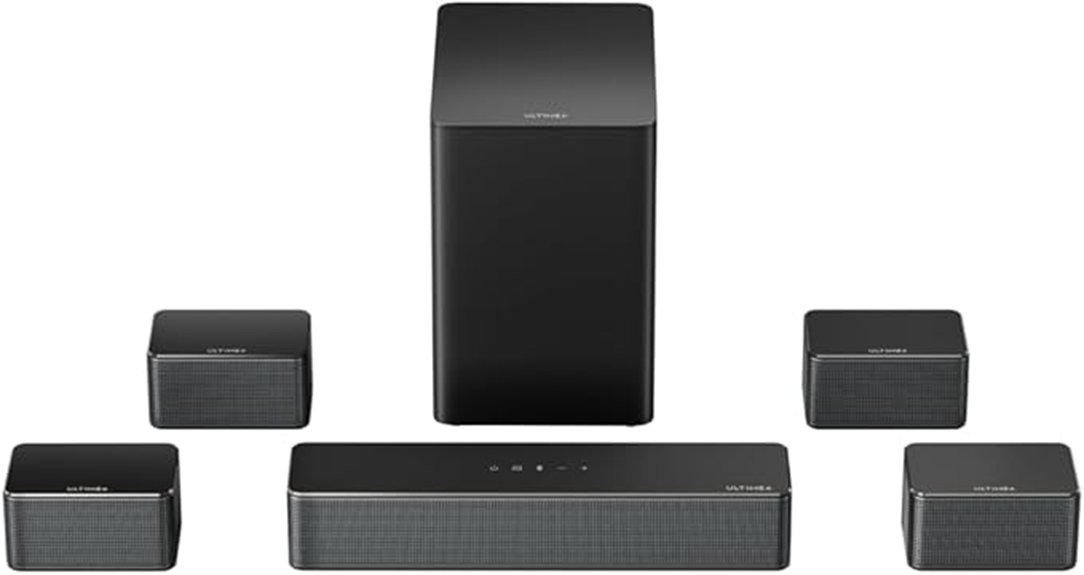
ULTIMEA 7.1ch Soundbar with Wireless Subwoofer

If you’re looking for an all‑in‑one audio upgrade that turns a plain TV room into a cinema‑grade theater, the ULTIMEA 7.1 ch soundbar is exactly what you need. Its 410 W peak power and 18 kHz range let you feel every detail in movies, music, or games. A 7.1 ch virtual surround plus four wired front and rear speakers make the sound bubble around you. The standalone 6.5‑in subwoofer and 20‑ft cable give flexibility and deep bass. HDMI, optical, Bluetooth 5.0, and analog options keep it simple to pair with any device. The SMART app gives 121 presets, a 10‑band EQ, and six modes.
Best For: movie buffs and home‑theater enthusiasts who want a realistic 7.1 ch surround experience with ample power, varied presets, and versatile connectivity.
Pros:
- 410 W peak power and 18 kHz range deliver deep bass and crisp highs for movies, music, and gaming.
- 7.1 ch virtual surround with four wired front & rear speakers creates an immersive sound bubble.
- Extensive EQ customization (121 presets, 10‑band EQ, 6 modes) via the SMART app and remote control.
Cons:
- Subwoofer not water‑resistant, limiting placement in damp areas.
- Requires a long 20‑ft wire to the subwoofer, which may limit room layouts.
- Power supply is corded only, and the soundbar lacks dedicated HDMI‑ARC or eARC support.
https://www.amazon.com/dp/B0DFM4PG23
ULTIMEA 5.1CH Dolby Atmos Sound Bar with Subwoofer

For the home‑theater enthusiast who craves immersive, theater‑grade audio in the living room, the ULTIMEA Poseidon M60 5.1‑channel sound bar delivers Dolby Atmos content directly to a wired subwoofer with just a single HDMI eARC connection. That 300‑watt peak gives a 45 Hz‑18 kHz range and 99 dB max SPL, while side‑firing drivers replace rear units for deep depth. The wired sub’s 18 mm driver delivers punchy lows thanks to a magnet. Connectivity stays eARC for lossless Dolby Atmos, plus HDMI ARC, optical, and Bluetooth 5.4. Setup takes under a minute, and VoiceMX sharpens dialogue. The app offers 10‑band EQ, 121 presets and OTA updates.
Best For: home‑theater lovers who want Dolby Atmos immersion, crystal‑clear dialogue, and a quick, all‑wired setup in a sleek bar form factor.
Pros:
- Dolby Atmos support via HDMI eARC with lossless delivery
- VoiceMX real‑time vocal isolation and enhancement for clearer dialogue
- Comprehensive app: 10‑band EQ, 121 presets, OTA updates, and remote controls
Cons:
- Limited 1‑year warranty typical for mid‑range units
- No water‑resistant construction – not ideal for damp environments
- Requires wired subwoofer and cables (no wireless sub option)
https://www.amazon.com/dp/B0F62YBNSX
Amazon Fire TV Soundbar Plus 5.1 Dolby Atmos

Amazon’s Fire TV Soundbar Plus transforms your living room into a premium cinema by delivering Dolby Atmos‑powered 5.1 channels and a wireless subwoofer that lets you feel every bass hit without tangled cables. It pairs with two external surround speakers for 5.1 immersion, while the 37″ bar handles playback. You’ll hear crystal‑clear dialogue from the center channel and lifelike 3‑D audio thanks to Dolby Atmos and DTS:X. Switching between Movie, Music, Sports, and Night modes sharpens each genre, and a single remote controls both TV and soundbar. Plug via HDMI, optical, or USB‑A, or use Bluetooth for phone pairing.
Best For: movie lovers who want a cinematic sound system without the hassle of many wires
Pros:
- Dolby Atmos and DTS:X deliver 3‑D, lifelike audio for true theater immersion
- Wireless subwoofer plus two external surround speakers eliminate cable clutter
- Multiple preset modes (Movie, Music, Sports, Night) let you adjust sound to content quickly
Cons:
- Limited to 5.1 channels; may not satisfy users seeking 7.1 or higher setups
- Requires a USB‑A or HDMI input on the TV; older models may lack HDMI 2.0 support
- One‑year limited warranty, with no free upgrades for future software or feature releases
https://www.amazon.com/dp/B0CXZHM5Q8
LG S40TR Home Theater Soundbar with Wireless Subwoofer

With its built‑in 4.1‑channel system and wireless subwoofer and rear speakers, the LG S40TR turns any living room into a true theater, making it the perfect pick for anyone who wants immersive surround sound without the bulk of a traditional receiver kit.
You plug it into your TV with the optical cable or Bluetooth. One remote handles both LG TV and the soundbar, and the app offers a 3‑band equalizer an “Up‑Mixer” turns stereo into surround. Clear Voice sharpens dialogue. Speaker and subwoofer stay tidy. Powered by 240 V AC and two AAA batteries, it weighs 12.9 lb and measures 28.4 in. wide.
Best For: those who desire a full 4.1‑channel surround experience in a compact, receiver‑free setup—perfect for home theaters in apartments or small living rooms.
Pros:
- Integrated wireless subwoofer and rear speakers eliminate the need for a separate receiver.
- One remote controls both the soundbar and an LG TV, plus a smartphone app offers a 3‑band equalizer and “Up‑Mixer” feature.
- Dual power options: mains 240 V AC and two AAA batteries for backup.
Cons:
- Requires two AAA batteries; battery life is limited compared to mains‑powered units.
- 28.4‑inch width may occupy significant space on small media centers or TV stands.
- Lacks HDMI ARC/eARC input, limiting connectivity options for newer TVs.
https://www.amazon.com/dp/B0D1CPPL85
Sony HT-S40R 5.1ch Home Theater Soundbar System,black

If you’re craving cinema‑style immersion without a sprawling speaker setup, the Sony HT‑S40R gives you a 5.1‑channel experience that cranks 600 W into the room and installs rear‑side speakers so the cinema‑grade sound feels enveloping—ideal for ultimate movie nights or casual gaming in tight spaces. Eight drivers deliver power, while tech keeps speech clear. Bar mounts behind TV and 1‑inch rear unit add depth without clutter. It supports HDMI, optical, analog, wireless Bluetooth, and USB port, letting it connect to TVs, laptops, phones, or tablets. Remote offers mode swaps, and AAA batteries provide backup. 454 g, bar‑mount compatible, black fits decor.
Best For: Movie and gaming enthusiasts who want a full 5.1 channel cinema‑grade experience in a compact, bar‑mount‑friendly package.
Pros:
- Powerful 600 W output with 5.1 channel surround for immersive audio
- Versatile connectivity (HDMI, optical, Bluetooth, USB) for multiple devices
- Compact design with rear‑speaker integration and bar‑mount compatibility
Cons:
- Limited outdoor use – not waterproof or water‑resistant
- No voice‑control or smart assistant integration
- Dual AAA batteries provide only short backup, requiring a power cord for full use
https://www.amazon.com/dp/B0961X3R2H
JBL 700MK2 Soundbar, DolbyAtmos, 780W, 10″ Wireless Subwoofer

The JBL 700MK2 Soundbar, powered by a 780‑W engine and built‑in Dolby Atmos, delivers cinema‑grade 3‑D audio in a compact shape. It forms a 7.1‑channel setup with wireless surrounds and a 10‑inch subwoofer that you can drop on the floor or mount. MultiBeam 3.0 spreads sound across your room, while PureVoice 2.0 sharpens dialogue and SmartDetails brings subtle on‑screen sounds to life. Night mode silences speakers via the JBL ONE app. With HDMI, Wi‑Fi, Bluetooth, AirPlay, and Alexa built‑in, you can stream from Spotify, Tidal, or Roon and control everything from phone. Two‑hand lift lets you reposition the bar effortlessly, brackets simplify installation.
Best For: movie buffs and home‑theater users who want Dolby Atmos in a space‑saving design, especially those with small living rooms.
Pros:
- 780 W engine and 7.1‑channel setup delivers immersive sound.
- Wireless detachable surrounds and subwoofer offer flexible placement.
- MultiBeam 3.0, PureVoice 2.0, and SmartDetails enhance audio detail and dialogue clarity.
Cons:
- 1‑year warranty may feel short for a premium system.
- Requires two AAA batteries for surrounds, necessitating regular charging.
- Limited HDMI ports may constrain connection to multiple devices.
https://www.amazon.com/dp/B0FJRM9GKQ
ULTIMEA 5.1 Sound Bar with Virtual Surround

Designed for movie buffs who crave immersive audio on a budget, the ULTIMEA 5.1 Sound Bar delivers virtual surround and a 10‑band equalizer in a compact 15.75‑in‑wide package. It mounts easily with the included wall bracket and screws, weighs 11.68 lb, and measures 3.54 in tall and 2.76 in deep. The 5.1 setup features dual 2.25‑in rear units, a 5.25‑in subwoofer, and 320 W peak power, offering 18 kHz response. Connect via HDMI ARC, optical, Bluetooth, or AUX, and control everything from a wireless remote or the ULTIMEA app. Customize sound with 121 presets or a 10‑band “Customize” mode for movies, music, or voice today.
Best For: movie enthusiasts who want immersive 5.1‑surround sound in a compact, budget‑friendly setup that’s easy to wall‑mount and supports HDMI ARC, optical, Bluetooth, and AUX connections.
Pros:
- Virtual 5.1 surround with dual rear speakers and a 5.25 in subwoofer delivering 320 W peak power.
- 10‑band customizable equalizer plus 121 preset modes for a tailored listening experience.
- Wireless remote and ULTIMEA app control, plus multiple connectivity options (HDMI ARC, optical, Bluetooth, AUX).
Cons:
- No built‑in TV tuner or smart‑TV integration beyond HDMI ARC.
- Not water‑resistant, limiting use near moisture or in humid environments.
- Audio profile may feel less dynamic compared to higher‑end 5.1 systems.
https://www.amazon.com/dp/B0DSPV7LJ7
Samsung B-Series 2.1ch Soundbar Subwoofer

When you want cinematic audio that keeps a compact living space uncluttered, the Samsung B‑Series 2.1ch soundbar delivers. The 11.8‑inch‑wide bar packs a 300‑watt punch, delivering crisp highs and depth that the wireless subwoofer amplifies for punchy bass. Plug it into your TV via HDMI ARC, and a single‑touch remote shows interface that auto‑dials the right settings for movies or podcasts, you’ll love. DTS Virtual:X drapes sound around you while Adaptive Sound tightens dialogue and eliminates unwanted echo. The Voice‑Enhance Mode boosts dialogue clarity, and the Bass Boost gives you deep rumble that feels immersive even in tight rooms.
Best For: people who want cinematic sound in a compact, clutter‑free living space
Pros:
- 300 W total output with a wireless subwoofer for deep, punchy bass
- DTS Virtual:X and Adaptive Sound for immersive, dialogue‑focused audio
- One‑touch remote that auto‑detects content and simplifies setup
Cons:
- Limited to a 2.1‑channel layout (no native 5.1/7.1 surround)
- Wall‑mount hardware is not included, requiring additional purchase
- Only a one‑year manufacturer warranty (30‑day return cover is retailer‑specific)
https://www.amazon.com/dp/B0DY1VSC7F
JBL Bar 1300XMK2 11.1.4 Channel Soundbar System

Craving a cinema‑grade experience? The JBL Bar 1300XMK2 powers 1570 W in a single bar, offering 11.1.4 channels that support true Dolby Atmos® and DTS:X. MultiBeam 3.0 spreads audio across the room, while the 12‑inch subwoofer throws deep lows. Three detachable, battery‑powered rear speakers float overhead, recharging on the bar. Bluetooth 5.x, AirPlay, Spotify Connect, and Alexa make it a plug‑and‑play hub. The JBL ONE app fine‑tunes EQ, migrates playback to other rooms, and pushes firmware updates—all from one remote. It keeps the cinematic vibe even after the credits roll today. Every footstep and booming dialogue feel as if a theater surrounds you.
Best For: Home theater enthusiasts who want a premium, immersive audio experience in a compact package with wireless convenience.
Pros:
- 1570 W maximum output and 11.1.4‑channel architecture delivering true Dolby Atmos® and DTS:X.
- MultiBeam 3.0 and a 12‑inch subwoofer create a room‑wide soundstage with deep bass.
- Wireless battery‑powered rear speakers and the JBL ONE app allow easy setup, migration, and firmware updates.
Cons:
- High price point and bulkiness (21.3 kg bar and heavy wiring).
- Requires non‑standard batteries for the rear speakers—extra cost and replacement.
- Connectivity limited to HDMI/Optical; no built‑in Wi-Fi return, which can cause disconnections.
https://www.amazon.com/dp/B0FN1JLNCN
Nakamichi Shockwafe Ultra 9.2.4 Soundbar with Dolby Atmos

If you crave cinema‑class audio right in your living room, the Nakamichi Shockwafe Ultra 9.2.4 delivers a 1,300‑W, 9.2.4‑channel system that supports both Dolby Atmos and DTS:X, creating a 360° sound field that feels like a theater inside your sofa. You’ll pair the bar with two 10‑inch wireless subs that each deliver 600‑W, hitting 20‑Hz lows. Four modular rear satellites weave a 360° surround built on 70+ years of audio engineering expertise, connected via a simple RCA link—not wireless—so you can position them to fit your room. Thanks to HDMI eARC, three HDMI inputs, 4K HDR passthrough, and 24‑bit Bluetooth aptX HD, the SSE MAX engine keeps each source crisp, immersive, and 1‑year warranty seamlessly.
Best For: cinema enthusiasts craving Dolby Atmos and DTS:X immersion in a sleek soundbar‑plus‑satellite package.
Pros:
- 1,300 W of maximum output delivers deep bass and razor‑sharp detail for movies and music
- Four modular rear satellites enable 360° sound fields that can be positioned to fit any room layout
- HDMI eARC, 4K HDR passthrough, and 24‑bit Bluetooth aptX HD ensure broad connectivity and future‑proofness
Cons:
- Each 23.8 lb subwoofer and the overall footprint make placement challenging in tight spaces
- The 1‑year labor and parts warranty falls short of industry leaders with multi‑year coverage
- Rear satellites rely on a wired RCA link; the lack of wireless sub‑to‑satellite connectivity limits aesthetic flexibility
https://www.amazon.com/dp/B08Z37YTVG
Samsung HW-C450 2.1 Soundbar w/ Subwoofer, Bluetooth, DTS

The Samsung HW‑C450 2.1 Soundbar turns any living room into a cinema, thanks to DTS Virtual X 3‑D audio that drops you right into the action.
It packs a 7.2‑inch woofer and a 228 mm driver that deliver 20 Hz lows, 80 dB SNR, and a clean mid‑range across a 33.8 W × 2.3 H enclosure.
The included subwoofer—powered by two AAA cells—boosts bass instantly, while the Bluetooth 10 m range lets you stream wirelessly from any smart TV.
DTS Virtual X, Adaptive Sound Lite, and Voice Enhance create immersive scenes, sharp dialogue, and gameplay‑specific focus with the Game Mode button.
Set Night Mode to tame volume.
Best For: gamers and home‑theater lovers looking for immersive sound without a full surround setup.
Pros:
- DTS Virtual X 3‑D audio delivers a cinema‑like experience.
- 10 m Bluetooth connection and optical cable give flexible source options.
- Wall‑mount kit and adjustable sub‑woofer enable simple, space‑saving installation.
Cons:
- Sub‑woofer needs two AAA batteries and the system is only corded electric.
- Not water‑resistant, making it unsuitable for humid or wet environments.
- Lacks HDMI ARC/optical audio return and relies solely on Bluetooth or optical input.
https://www.amazon.com/dp/B0BVWFZC7L
Bose Compact Bluetooth Soundbar with HDMI-ARC

You want a compact yet powerful home‑theater upgrade, and this Bose soundbar delivers just that—its 23‑inch width fits right behind the TV while its built‑in Dolby decoding powers clear, cinematic sound.
You’ll pair it via Bluetooth‑4.2 or connect through the optical jack or an HDMI‑ARC cable you buy. Its two drivers and tweeter spread sound evenly, while 35‑W peak power keeps dialogue sharp. The remote offers dialog or bass‑boost modes, and LED status lights show volume levels glance. Expand with a Bass Module 500 or 700 by plugging a cable or a 3.5‑mm line. Weighing 7.6 lb, it stays light for placement.
Best For: A TV‑centric viewer who wants an easy, noise‑free audio upgrade with clear dialogue and optional bass expansion, all without a bulky speakers arrangement.
Pros:
- Built‑in Dolby decoding delivers cinematic audio clarity with 35 W peak power in a compact 23‑inch footprint.
- Flexible connectivity: Bluetooth 4.2, HDMI‑ARC, and optical inputs allow quick pairing with any smart TV or external source.
- Light, wall‑mount‑ready design (7.6 lb) fits neatly behind most TV sets for a tidy home‑theater look.
Cons:
- 1‑year limited warranty and a 30‑day return window may be insufficient for users seeking long‑term protection.
- Not waterproof or even water‑resistant, limiting use in damp or splash‑prone environments.
- Expanding the soundstage requires purchasing a separate Bass Module 500 or 700 and additional connecting cables.
https://www.amazon.com/dp/B088KRPCQJ
LG S80TR OLED evo TV with Soundbar

For audiophiles craving cinematic immersion, the LG S80TR’s 5.1.3‑channel Dolby Atmos soundbar delivers studio‑quality surround sound in a sleek, wall‑mount‑ready chassis.
You’ll appreciate its 5‑inch drivers housed in a metal enclosure that weighs 42.1 lb yet mounts cleanly. The 5.1.3‑channel layout, complete with wireless subwoofer and rear speakers, reshapes your room into a theater. Center‑fire torqued speaker boosts dialogue, while Cinemax AI mode creates 3‑D spatial sound—except when you switch to Bass Blast. HDMI, Bluetooth, Wi‑Fi, AirPlay 2, Chromecast, and voice assistants stream instantly. The built‑in mic auto‑calibrates, and the WOW Interface lets one remote control everything.
Enjoy cinema‑quality sound without clutter.
Best For: home theater aficionados who want a wireless 5.1.3 channel Dolby Atmos experience that pairs cleanly with an LG OLED Evo TV and offers streamlined remote control.
Pros:
- Dolby Atmos & DTS:X-enabled 5.1.3 layout with wireless rear speakers and subwoofer for cage‑free room‑shaping.
- Built‑in microphone with auto‑room‑calibration and a unified WOW interface for single‑remote TV + soundbar control.
- Robust connectivity: HDMI, Bluetooth, Wi‑Fi, AirPlay 2, Chromecast, and voice‑assistant (Google / Alexa) support.
Cons:
- Heavy 42.1‑lb metal chassis can make wall‑mounting or repositioning cumbersome.
- Requires a separate TV connection; not a fully integrated built‑in audio solution.
- 1‑year limited warranty and premium pricing may not suit tighter budgets.
https://www.amazon.com/dp/B0CX3SHJDC
MZEIBO 120W Soundbar with Subwoofer

Looking for theater‑grade sound without the messy wiring? You’ll get 120 W peak, 80 W net power from the MZEIBO 120W soundbar, powering a 5.1‑channel surround system that hits a 20 kHz range with drivers. Its subwoofer throws deep bass that fills your room. Connect via Bluetooth 5.3, ARC, optical, AUX, RCA, or HDMI‑CEC—wireless streaming from phone, tablet, or TV, plus wired HDMI/optical/3.5 mm for consoles and receivers. One‑step assembly lets you wall‑mount the 31‑inch model or set it on a table, saving space. The sleek black chassis blends into décor, and the 36‑month warranty offers peace of mind, for movie marathon, nights everywhere.
Best For: movie‑goers and gamers looking for an affordable, wall‑mountable 5.1‑channel sound system with robust power and wireless streaming.
Pros:
- 120 W peak power and 80 W net output deliver punchy audio for any room size.
- Includes a subwoofer for deep bass and full 5.1–channel surround coverage.
- Multiple connectivity options (Bluetooth 5.3, ARC, optical, HDMI‑CEC, AUX, RCA) for hassle‑free setup.
Cons:
- Lacks built‑in room‑calibration or automatic speaker alignment.
- No WiFi connectivity or app‑based remote control.
- Limited to DLNA/Dolby Digital; no dedicated Dolby Atmos or DTS:X support.
https://www.amazon.com/dp/B0FKBHJPJ9
Factors to Consider When Choosing a Home Theater Soundbar System
You’ll want to compare how clear audio spreads in the room and how many zones the soundbar can fill.
Make sure it offers the HDMI‑ARC, optical input, or Bluetooth you need to keep all your devices talking.
Check that its wattage matches your loudness needs, its speaker arrangement keeps dialogue sharp, and its remote or app lets you tweak settings on the fly.
Audio Quality and Coverage
Because an immersive soundscape hinges on how effectively a system projects audio around the listener, evaluating its channel layout and power capability should come first. You’ll want a 7.1‑channel virtual surround that spreads sound beyond the front, giving you sharper dialogue localization and richer environmental cues. A peak power rating of 400‑800 W paired with an 18 kHz high‑frequency response lets the bar deliver punchy bass and razor‑sharp highs, keeping fast‑moving scenes clear. Built‑in 10‑band equalizers and 120 preset curves let you fine‑tune lows, mids, and highs for movies, music, or games without losing balance. Wireless subwoofers and detachable rear modules keep the kit cable‑free yet provide full rear coverage, while Dolby Atmos or DTS:X upward drives add a vertical dimension for true 3‑D sound today.
Connectivity Options and Compatibility
If you want to get the most out of your home theater, choosing a soundbar with robust connectivity is essential. HDMI eARC delivers up to 37 Mbps, letting you stream lossless Dolby Atmos 5.1 from your TV without interruption. An optical port still supports up to 8‑channel PCM or Dolby Digital, so older setups stay compatible. Bluetooth 5.0/5.4 provides a 10‑meter range for low‑latency streaming of MP3, AAC‑LD, or FLAC files when you need wireless flexibility. Built‑in USB‑A or USB‑2.0 ports let you play external media—MP3, WMA, MXF—directly from a card or drive. CEC‑enabled HDMI and ARC let one remote command both TV and soundbar, simplifying control across devices. Plus, many units feature Wi‑Fi and AirPlay 2, letting you stream directly from phones, tablets, or smart TVs everywhere.
Power and Output Requirements
While peak power makes a big splash on the spec sheet, it’s the RMS rating you will actually hear and rely on for everyday listening. Check that the soundbar’s RMS output matches your room’s volume needs—aim for roughly 10 W of RMS per 10 m² of living space. Verify the peak figure lets you hit cinematic highs without distortion, and confirm the advertised SPL tops out near 99 dB so you don’t clip on a thrilling chase. Guarantee an SNR over 80 dB to keep hiss out of your live‑action audio. Finally, look at the woofer’s wattage, impedance, and enclosure volume; a capable driver prevents brown‑out and overheating during bass‑heavy scenes. A well‑matched power circuit also protects the amplifier from overload, extending its lifespan and preserve clarity always.
Speaker Layout and Imaging
When you pick a soundbar, the channel count—2.1, 5.1, 7.1, or even 9.2—tells you how many separate audio paths you’ll have, and that directly shapes positional realism. Your layout choices dictate how listeners perceive depth, width, and clarity. Position rear or dual‑rear drivers at roughly ±30° from the listening axis—the “60° rule”—to align them with your hearing field, which dramatically expands the audio stage. Placing a dedicated center driver beneath your display keeps dialogue anchored; a bar‑mounted center can off‑axis sound. Many modern bars use virtual surround algorithms to synthesize rear and height cues, letting a single unit emulate a 5.1 or higher setup. Add up‑firing speakers that sit at least 20 cm above or below ear level to lift action into a three‑dimensional envelope for Atmos‑compatible titles.
Remote Control and App Features
Four key elements can make or break a soundbar’s usability: the remote, the mobile app, voice‑assistant integration, and connectivity options. You’ll appreciate a remote that programs 4‑wire mode buttons—movie, music, gaming, night—plus quick‑mute and separate power and pairing keys for Bluetooth or Wi‑Fi. The accompanying app should let you push firmware updates wirelessly, tweak a 10‑band equalizer, and flip through 120 presets to nail your room’s acoustics. Voice controls via Alexa, Google, or Siri give you hands‑free volume lifts and a quick “dialogue‑enhance” toggle, letting you focus on the movie instead of the remote. Don’t miss the HDMI‑ARC/eARC and CEC menus exposed on both interfaces—switching takes a touch, and you can fine‑adjust surround levels for Dolby Atmos without a joystick. You’ll love the build‑quality.
Installation and Mounting Flexibility
Once you’re comfortable with the remote and app controls, the next step is mapping out where the soundbar will live. If your setup allows, a 20‑ft rear‑wire cable can send signals to a subwoofer placed off‑center, giving you freedom to position it on a side wall or corner without limiting audio quality. Most kits include wall‑mount brackets; align the mounting holes, secure the plate, and you’ll have a flush, invisible placement. Remember the bar’s depth—usually 3‑4 inches—so it stays a safe distance from the wall and keeps venting clear. Alternatively, set the bar on a firm shelf; its 10‑15 lb weight demands a sturdy surface, especially if you add wired surrounds. Portable surrounds add flexibility, letting you attach them up to ten feet with floor‑stand brackets.
Subwoofer Placement and Performance
If you want deep, tight bass, the subwoofer’s location matters more than the speaker itself. Placing it 3–6 feet from a wall can boost low‑frequency response by 3–6 dB, but avoid standing‑wave traps in rooms under 15 sq ft. Use an isolation pad or carpet under a 6.5‑inch or 10‑inch driver to cut chassis vibration and sharpen bass by up to 12 %. Keep a dedicated 18 AWG (or thicker) cable under 10 ft to avoid losing 1–2 dB at 60 Hz. Position the sub at least 1.5 ft from the main soundbar, avoiding cancellation in 5.1/7.1 setups. For wireless subs, secure line‑of‑sight, avoiding metal vents or thick walls; this keeps bandwidth to 18 kHz and latency below 0.5 ms and a richer sound.
Budget and Warranty Considerations
Before you head for a new soundbar, map your budget to the typical price tiers. Entry‑level 2.1 systems start around $200, while mid‑tier models range from $500 to $1,200. Premium 7.1 or Dolby Atmos rigs push over $2,000. Most manufacturers offer a one‑year warranty on defects; you can add an extended 3‑year plan for 10–15 % of the price. Shipping, handling, and installation can add another 10–30 % to the retail cost, especially for bulky setups that need brackets or professional cabling. Wireless subwoofers or detachable rear speakers often carry separate 6–12‑month warranties that run parallel to the main coverage. Finally, free OTA firmware updates extend functionality without extra cost, effectively lengthening a system’s useful life. Your informed choice guarantees both performance and peace of mind.
Frequently Asked Questions
Do Soundbars Support Auto‑Center Channel Calibration?
Yes, many soundbars support auto‑center channel calibration, so you can let your system automatically find and adjust the center speaker spot. When you turn it on, the bar’s built‑in microphones walk through a quick setup sequence, measuring reflections and power levels. It then outputs tuned settings, ensuring dialogue clarity and balanced sound. This feature saves you manual tweaking and guarantees a precise, immersive listening experience. In your living room tonight.
Can I Connect a Soundbar to Gaming Consoles via HDMI ARC?
Imagine a dragon roaring right into your living room, because you can plug your gaming console into your soundbar via HDMI ARC. The console connects to your TV, and the TV then sends the audio through its ARC port to the soundbar. Basically, you’ll need a TV with HDMI ARC (or eARC) and a soundbar that supports that standard. Once that’s set up, your game audio will explode into surround sound.
What Is the Difference Between Dolby Atmos and DTS:X on a Soundbar?
Dolby Atmos and DTS:X differ mainly in how they manage height cues. Atmos assigns a dedicated height channel per speaker, giving clear vertical layers, while DTS:X uses object‑based audio that places sounds anywhere within a 3‑D space. You’ll use virtual height for both, but DTS:X can place voices more precisely in smaller rooms. Atmos may sound bolder; DTS:X, sharper, depending on layout and deliver a more lifelike experience for you.
How Long Does a Typical Soundbar Battery Last on Standby?
A typical soundbar battery lasts about 20 to 30 hours on standby before you need to recharge it. You’ll notice power consumption drops sharply when you put the unit into standby mode, thanks to low‑power circuits. If you keep it always connected, you can simply plug it in and avoid battery fuss. Still, if you want portability, expect about a full day of standby life before recharging in the future.
Is It Possible to Upgrade a Soundbar’s Firmware After Purchase?
Imagine this: as you slide a finger across your soundbar, an unexpected wave of firmware updates dances across the screen, like a sudden thunderclap that aligns with your favorite movie’s climax. You’ll discover upgrades, if the manufacturer supports them, through the connected app or USB drive. Keep an eye on the brand’s website, breathe easy—many updates arrive quietly, enhancing performance without a costly remodel and feel your entertainment grow richer.
Conclusion
Picture the room humming with cinematic sound, you standing close to the floor‑to‑ceiling speakers that wrap around you. Each bass thump feels like a drumroll, every dialogue crystal clear, pulling you into the story. With the right soundbar, your living space turns into a concert hall without the crowds. Let the music guide you, and you’ll never leave the theater again. Your senses elevate, and memories resonate long after the credits roll for unforgettable moments.

Introducing Maria, our meticulous planner and talented visual storyteller. She has a knack for discovering those hidden gems, chic boutique spots, and charming little cafes that add a touch of elegance to every journey. With her keen eye for photography and her passion for travel, Michelle will transport you to the most enchanting corners of the world, inspiring you to explore new places, one picture-perfect destination at a time.