Tag: tap water quality

Top Whole-House Water Filter That Keeps Your Tap Clean

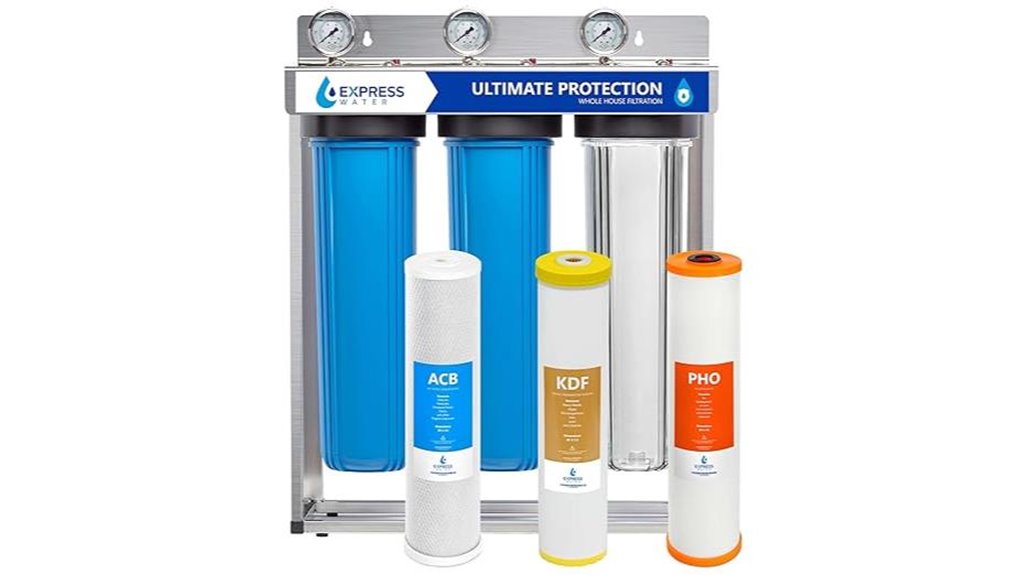
If you’re looking for the best whole‑house filter to keep every tap crystal‑clear, the Express Water 3‑Stage stands out. For plumbing, quality, and peace of mind. It pauses chlorine, chloramine, PFAs, and heavy metals with activated‑carbon, KDF, and polyphosphate media, and handles up to 17 GPM at high pressure. Other great choices include HQUA’s 20‑inch system for high TDS, iSpring’s iron‑manganese combo, and AO Smith’s long‑lasting cartridge. Want the rundown? Let’s keep going, see why it matters.

Key Takeaways

  • Three‑stage whole‑house filters (activated‑carbon, KDF, polyphosphate) eliminate chlorine, chloramine, PFAs, and heavy metals for clear, safe tap water.
  • Models like Express Water’s KDF‑GAC combo deliver up to 17 GPM while meeting 20–80 PSI demand, preserving consistent pressure and filtration.
  • Iron‑manganese media (iSpring WGB32BM) removes ferrous and manganese up to 3 ppm, preventing red stains and off‑taste while keeping minerals.
  • Large cartridge capacity (~100 000 gal) means a yearly replacement cycle, preventing clogging and sustaining filtration performance.
  • Low‑maintenance designs (pre‑loaded housings, countdown timers, tool‑free installation) let homeowners keep taps clean without frequent hassle.

Express Water 3-Stage Whole House Filter

express water 3 stage filter

If you’re looking for a whole‑home filter that tackles the toughest contaminants without any downtime, the Express Water 3‑Stage system is built for you. Installed in any standard home, it sits on a stand‑alone stainless‑steel frame with three pressure gauges and simple manual release buttons. Its three‑stage combo—activated‑carbon, KDF, and polyphosphate—scrubs chlorine, chloramine, PFAs, plus heavy metals like lead, arsenic, mercury, chromium, and cadmium. You’ll enjoy up to 17 GPM at 20–80 PSI, operating between 4.44 °C and 100 °F, and a 100,000‑gallon lifespan. Replace the cartridges every 6–12 months, or after 100,000 gallons, and reset gauges with the quick‑release handle. No power required, and a one‑year warranty backs reliability. Consequently, you’ll keep every faucet pure, protect pipes from scaling, and enjoy crisp, clean water all year round.

Best For: homeowners and families who need a reliable, power‑free whole‑house filtration system that removes heavy metals, PFAs, chlorine, and controls scale, especially in hard‑water regions.

Pros:

  • Comprehensive three‑stage filtration (activated carbon, KDF, polyphosphate) effectively removes heavy metals, PFAs, chlorine, chloramine, and manages scale buildup.
  • High flow capacity of up to 17 GPM and a 100,000‑gallon lifespan provide continuous, large‑volume household protection without frequent replacements.
  • Fully stainless‑steel frame with built‑in pressure gauges and manual release buttons eliminates the need for power and allows quick gauge reset and easy maintenance.

Cons:

  • Replacement cartridges must be swapped every 6–12 months or after 100,000 gallons, which can add ongoing maintenance costs.
  • The product comes with only a one‑year manufacturer warranty, less than some competitors.
  • Manual gauge reset and lack of digital monitoring may be inconvenient for users who prefer automated or remote‑monitoring features.

https://www.amazon.com/dp/B0BBZ8VZH1

HQUA WF3-01 3-Stage Whole House Water Filter

hqua 3 stage whole house

Because you need water that’s free from sediment, bad odors, and heavy metals, the HQUA WF3‑01 3‑Stage Whole‑House Filter is a smart choice. It uses a 20” × 5.5” sediment cartridge to remove dirt, rust, and sand; a carbon block to treat cloudiness and odors; and a GAC + KDF filter that captures lead, mercury, copper, nickel, chromium, and chloramine. The ABS housing measures 31” × 23” × 8” and includes brushes, pressure‑relief, drain valves. No orientation rules simplify installation. It runs 25–116 psi, 15 gpm, supports 500 ppm TDS, lasts ten years. gauges and 180‑day timers alert you to replace cartridges, while a maintenance card records dates and pressures.

Best For: households, RVs, or boat owners who need a single, long‑lasting system to remove sediment, odors, VOCs, and heavy metals from all water sources.

Pros:

  • 3‑stage design cleans sediment, odors, VOCs, and heavy metals in one unit.
  • Built‑in 180‑day countdown timers, pressure gauges, and maintenance card provide real‑time monitoring and reminders.
  • ABS housing with long brushes and pressure relief valves offers durability and up to 10‑year shelf life.

Cons:

  • The 20”×5.5” cartridges are bulky and may not fit in smaller wall spaces.
  • Cartridges need replacement every 180 days, adding ongoing costs.
  • The system only supports up to 500 ppm TDS, so it won’t handle very high mineral loads.

https://www.amazon.com/dp/B0D4K1LQ14

iSpring Whole House 3-Stage Iron Filter (WGB32BM)

ispring 3 stage iron filter

When your tap water tastes rusty, the iSpring Whole‑House 3‑Stage Iron Filter (WGB32BM) isn’t just a filter—it’s a whole‑house solution that removes up to 3 ppm of iron and 1 ppm of manganese while preserving essential minerals. It captures sediment with a 5‑µm polypropylene screen, then purifies through a coconut‑shell carbon block, and finally removes ferrous iron and manganese without stripping nutritious minerals. The cartridges last about 100,000 gallons, keeping a family of four supplied for an entire year. Installation is plug‑and‑play, using standard 1‑inch NPT fittings, and the kit includes a wrench and a concise guide. Warranty covers first year.

Best For: families with iron‑rich tap water who need a full‑house solution that removes iron, manganese, and sediment without stripping essential minerals.

Pros:

  • 100,000‑gal cartridge life keeps a household supplied for an entire year
  • 3‑stage design eliminates iron, manganese, chlorine, and sediment while preserving healthy minerals
  • Simple DIY plug‑and‑play installation using standard 1‑inch NPT fittings

Cons:

  • Requires a minimum flow of up to 15 GPM, which can be a limitation in low‑pressure homes
  • The iron‑manganese media is not consumable, so the entire filter pack must be replaced periodically
  • Does not reduce total dissolved solids (TDS), so additional filtration is needed if TDS removal is desired

https://www.amazon.com/dp/B01FI3BLYM

Whole House Water Filter, 3/4″ Ports, Two Valves

whole house inch dual valves

For homeowners who want reliable, high‑pressure water, the 15 GPM whole‑house filter delivers strong flow while a triple‑stage cartridge series captures chlorine, rust, and fine particulates—so every tap stays crisp. With 3/4‑inch ports and two valves, you can split flow for kitchen sinks and garden hoses while keeping steady pressure. The 0.5 µm cartridge removes sediments and metals, keeping appliances cleaner. Installation is quick: twist the shut‑off, drop a cartridge, and seal with double O‑rings—no plumbing tools needed. Two spare sets ship free, and swaps take a minute. Your water stays mineral‑rich, tastes fresh, clean, and laundry emerges softer and brighter.

Best For: homeowners with well or city water who need high‑pressure (15 GPM) filtration and want to protect appliances, reduce chlorine and sediment, and maintain mineral content without frequent plumbing work.

Pros:

  • Triple‑stage 0.5 µm cartridge system removes chlorine, rust, and fine particles while preserving beneficial minerals.
  • 3/4” multiple ports and dual valves let you split flow to kitchen sinks or garden hoses without losing pressure.
  • Drop‑in, twist‑shut‑off design with double O‑rings allows cartridge changes in under a minute with no tools.

Cons:

  • Requires regular cartridge replacement (every 4–6 months) which incurs ongoing cost.
  • 10,000‑gallon capacity is moderate; large households may outpace the filter sooner.
  • Initial purchase includes only two spare cartridge sets; additional sets must be bought separately.

https://www.amazon.com/dp/B0FKBCPC69

AO Smith Whole Home Water Filter System

aosmith full house filtration

If you’re managing a family of four or more, the AO‑Smith Whole House Water Filter System delivers clean, chlorine‑free water to every tap—cutting that 96.9 % of chlorine taste and odor in one central, DIY unit that doesn’t require a plumber. It’s built from fiberglass and measures 30 inches long, 9 inches wide, and 9 inches tall—fits in most closets. The unit runs at 7 gallons per minute while staying cool up to 90 °F, so you get flow without overheating. Maintenance is: swap the cartridge six years or 600,000 gallons, whichever comes first. NSF‑approved filter keeps TDS, sulfur, iron unchanged.

Best For: families with four or more people who want a single, DIY whole‑house water filter that eliminates chlorine taste and odor without plumbing labor.

Pros:

  • Removes 96.9 % of chlorine taste and odor, improving water quality city‑wide.
  • Easy, no‑plumber DIY installation with a 6‑year limited warranty.
  • Runs at 7 gal/min with a high 90 °F temperature tolerance, ensuring consistent flow.

Cons:

  • Requires cartridge replacement every 6 years or after 600,000 gallons, whichever comes first.
  • The fiberglass housing is relatively bulky, potentially limiting placement in tight spaces.
  • Does not alter TDS, sulfur, or iron levels, so it won’t address those contaminants.

https://www.amazon.com/dp/B07R8GW6BJ

PUREPLUS 5 Micron Whole House Filter 2-Pack

pureplus dual 5 micron filters

The PUREPLUS 5 µm filter packs a punch for homeowners running 10 × 4.5‑inch heavy‑duty housings—whether you’re resting on a GE, Culligan, or Pentek system. It removes up to 99 % of chlorine, sand, rust, and sediment, while preserving harmless minerals and keeping TDS unchanged. With a 30 000‑gal capacity and a 5 µm cutoff, it lasts 30 % longer than standard cartridges. A triple‑polypropylene core and coconut‑shell carbon give you proven NSF 42 performance. Fits 10 × 4.5‑in housings, mounts without tools, and comes from a brand with ISO 9001 and 200 patents. You’ll also get a 30‑day return policy and no BPA, and reliable water quality daily.

Best For: homeowners with 10 × 4.5‑inch heavy‑duty whole‑house filter housings (GE, Culligan, Pentek, etc.) who want longer service life, superior chlorine and sediment removal, and BPA‑free, NSF 42‑certified filtration.

Pros:

  • 30 % longer service life with a 5 µm cutoff, holding up to 30,000 gal for optimal protection.
  • Triple‑polypropylene core with coconut‑shell carbon delivers NSF 42 performance, cutting chlorine, sand, rust, and sediment up to 99 %.
  • Easy, tool‑free installation and wide compatibility with multiple brands.

Cons:

  • Higher upfront cost compared to generic cartridges may deter budget‑conscious buyers.
  • Replacement required every 30,000 gal; frequent changes needed in high‑usage homes.
  • Limited to 10 × 4.5‑inch housings; users with different filter sizes must seek alternatives.

https://www.amazon.com/dp/B01N2H2OO6

Waterdrop Whole House 5-Stage Filter

waterdrop whole 5 stage filter

Because you demand a safe, great‑tasting water supply throughout your home, the Waterdrop Whole‑House 5‑Stage Filter delivers a four‑stage filtration system that eliminates lead, chlorine, benzene, and rust while maintaining a steady flow up to 15 gpm. Its five stages—sediment, 5 µm PP, coconut‑shell GAC, another sediment, and a polishing layer—tackle lead, chlorine, benzene, mercury, rust, sand, odors, and taste. Replace the PP filter every 3–6 months and the GAC half‑yearly; the unit holds 50,000 gallons before full change. Polypropylene housings survive 25–90 psi and 100,000 water‑hammer events. Installation is DIY: a hose, wrench, Teflon tape suffice, and the (WD‑WHF21‑PG) meets NSF/ANSI 372.

Best For: homeowners seeking a whole‑house solution that removes lead, chlorine, benzene, mercury, and rust while maintaining a steady flow up to 15 gpm.

Pros:

  • Five‑stage design captures a broad spectrum of contaminants—lead, chlorine, benzene, mercury, rust, sand, odor, and taste.
  • DIY kit includes all necessary tools (wrench, Teflon tape, housing scraper) for quick, tool‑only installation.
  • Polypropylene housing withstands 25–90 psi and over 100,000 water‑hammer events for long‑term durability.

Cons:

  • Filters need replacement every 3–6 months (PP) and every 6 months (GAC).
  • No power or pumping—flow is limited to passive 15 gpm.
  • Single 1‑inch inlet/outlet may require adapters for some plumbing configurations.

https://www.amazon.com/dp/B08XXJSN29

iSpring WGB21B 2-Stage Whole House Filtration System

ispring 2 stage whole house

Looking for a whole‑house filter that trims chlorine, cloudiness, and sediment without stripping minerals? The iSpring WGB21B delivers. Its 26 × 19 × 11‑inch, 21.8‑lb unit sits on an alloy‑steel bracket with 1‑in inlet/outlet ports, so it plugs directly into your main line. Stage 1 uses a 5‑µm PP sediment cartridge (FP15B) to ban dirt, sand, rust, scale, and dust. Stage 2 adds a 2‑stage catalytic oxidizer (FC15B) that cuts chlorine by over 90 % and removes VOCs. No power needed—mechanical and chemical action suffice. It processes 50,000 gal a year at 15 gpm, easy swap cartridges with a quick‑release valve and wrench, offers 30‑day refund and warranty.

Best For: Whole‑house plumbing that needs effective chlorine, cloudiness, and sediment removal while preserving beneficial minerals, especially for a 4‑person household.

Pros:

  • No electricity required – purely mechanical and chemical filtration.
  • Two‑stage design captures fine sediment (5 µm) and then neutralizes chlorine/VOCs.
  • Large cartridge life (≈ 50,000 gal/yr) and easy cartridge changes with a quick‑release valve.

Cons:

  • Bulkier than point‑of‑use units; requires enough space for the 26 × 19 × 11 in bracket.
  • Initial unit cost higher than single‑stage filters.
  • Replacement cartridges can be pricey over time.

https://www.amazon.com/dp/B01F9A4UVU

ICEPURE 1 Micron House Filter, Pack of 4

icepure 1 micron 4 pack filters

If you’re a family that relies on tap water for everything—from drinking to cooking to laundry—this 1‑micron cartridge gives you peace of mind with a 13,000‑gallon, six‑month replacement cycle that knocks 99 % of chlorine, taste and odor right out of the water. Its compact 2.5″ × 10″ dimensions fit easily in most systems, and the activated‑carbon sintered media captures fine sediment while eliminating impurities. BPA‑free and certified by NSF/ANSI 42 as well as EU EC1935‑2004 and Australian Water Mark, you can trust it meets strict safety standards. Packaged with four replacements, the set keeps your taps clean and you enjoy lasting peace.

Best For: families who rely on tap water for daily use and want a long‑lasting, low‑maintenance, certified filter.

Pros:

  • 13,000‑gallon service life with a simple six‑month replacement cycle.
  • NSF/ANSI 42 certification and EU/ Australian regulations give confidence in safety and performance.
  • Compact 2.5″ × 10″ size fits most standard whole‑house and RO systems.

Cons:

  • Not designed for well water with large mud or sand; best for tap water only.
  • Requires regular replacement every six months—may be inconvenient for some users.
  • The single 1‑micron rating may not remove all particulates larger than 1 µm that some households need.

https://www.amazon.com/dp/B084DPJW37

VEVOR 3-Stage Whole House Water Filter System

three stage whole house filter

The VEVOR 3‑Stage Whole‑House Water Filter System—anchored by a heavy‑metal‑blocking KDF core—makes it ideal for families that want city‑quality water right at the tap.

You’ll install it on the 1 NPT inlet, choose floor‑standing or wall‑mounted, and use the included round wrench to swap 4.5 × 20 in. cartridges in minutes.

Stage 1 removes rust and sand with a polypropylene filter, Stage 2 blocks chlorine, lead, and H₂S, and Stage 3 captures remaining tastes and odors.

The system pushes up to 15 GPM and handles 300 ppm TDS, giving you up to 100,000 gal of clean water before a cartridge change.

Let the gauge warn you when replacement’s due.

Best For: families seeking city‑quality water at every tap with heavy‑metal removal for a whole‑house system.

Pros:

  • Removes heavy metals (lead, arsenic, chromium) and chlorine while keeping a 15 GPM flow.
  • 4.5 × 20 in. cartridges fit most homes; built‑in gauge alerts for easy maintenance.
  • 4‑stage design (sediment, KDF, activated carbon) offers comprehensive taste, odor, and contaminant control.

Cons:

  • 48.9 lb weight can make mounting or handling a bit cumbersome.
  • Cartridge replacement every 6–12 months may add ongoing costs.
  • Requires a 1 NPT inlet; incompatible with systems needing a 1/2‑inch or 3/4‑inch connection.

https://www.amazon.com/dp/B0FH543D7F

Waterdrop 3-Stage Whole House Filter System

waterdrop triple stage filter

You’ll appreciate the Waterdrop 3‑Stage Whole‑House Filter’s 12‑month cartridge life, which keeps your tap water clear of chlorine and sediment for an entire year—ideal for families who rely on well water and want minimal maintenance. With a 7‑stage design—KDF composite, high‑grade carbon fiber, and sediment filters—it cuts up to 97.2 % of chlorine and captures sand, rust, and large particles. You’ll enjoy a steady 15 GPM flow within 40 °F to 100 °F, and its 100,000‑gal capacity means you avoid frequent cartridge swaps. Installed on a countertop, the 22.9 L box weighs 19.1 kg but runs at 38 °C max, safe for most homes and covers use.

Best For: families using well water who want a year‑long, low‑maintenance filter that delivers steady 15 GPM flow and removes chlorine, sediment, and rust.

Pros:

  • 12‑month cartridge life reduces the need for frequent changes, saving time and money.
  • 100,000‑gal capacity and 15 GPM steady flow maintain consistent water pressure for household use.
  • 7‑stage design (KDF composite, high‑grade carbon fiber, sediment filters) cuts up to 97.2 % of chlorine and captures sand, rust, and large particles.

Cons:

  • Requires countertop space and adds 19.1 kg weight to the kitchen or utility area.
  • Maximum operating temperature of 38 °C (100 °F) may limit use with hot water systems that exceed this threshold.
  • 5 µm filtration rating may not remove ultrafine particulates or certain dissolved contaminants.

https://www.amazon.com/dp/B07C5P8NC7

PUREPLUS 5 Micron Whole House Water Filter

whole house 5 micron filter

Because municipal water systems routinely leave behind chlorine and chloramines, this 5‑micron two‑stage filter keeps them at bay while still letting minerals stay in the stream.

You install the 10‑inch housing in any 1‑in. NPT port, and the setup protects every faucet and appliance in your home.

You get two cartridges—first a 5‑µm sediment pre‑filter, then a coconut‑shell carbon block—that remove over 99% of chlorine, chloramines, odors, and harmful chemicals while preserving essential minerals.

Comes with a gauge that alerts you when the 30,000‑gallon filter life nears its end, so you guess when to replace, it’s NSF/ANSI 42 certified today.

Best For: homeowners who rely on municipal water and want a whole‑house filter that eliminates chlorine and chloramines while preserving essential minerals without compromising appliance life.

Pros:

  • Dual‑stage 5 µm filtration removes >99 % of chlorine, chloramines, odors, and chemicals, protecting appliances, fixtures, skin, and taste.
  • 30,000‑gallon life with an integrated pressure gauge that signals when to replace cartridges, making maintenance simple and predictable.
  • NSF/ANSI 42 certified, food‑grade polypropylene construction, and a 10‑inch universal housing that fits any 1‑in. NPT port.

Cons:

  • 5 µm pore size does not remove bacteria or viruses, so it’s not a full‑spectrum water treatment solution.
  • Cartridge replacement costs can add up over time compared to single‑stage filters.
  • The gauge relies on user interpretation; some users may find it confusing to decide when “nearing end” is appropriate for replacement.

https://www.amazon.com/dp/B0F432LBC2

Express Water Whole House Replacement Filter Set

express whole house filter

If you need a filter that tackles iron, lead, and chloramines while maintaining full‑house flow, the Express Water Whole‑House Replacement Filter Set is a smart choice. Equipped with KDF, polyphosphate, and activated‑carbon stages, it eliminates metals, scale, chlorine, and odors. The 3‑pack fits the standard WH300SCKP, measuring 4.5 × 20 inches, keeping pressure drop minimal. With a 100,000‑gallon lifespan, it delivers about 150 gal/min and operates from 45–80 psi across 40–100 °F. Install it on a dry, level surface away from heat, and enjoy up to a year of continuous, clean water. Amazon offers a 30‑day return, while the manufacturer backs it with a warranty for peace of mind. It also supports laundry, showers, and appliances without compromising household pressure. Upgrade today and feel the difference in every glass and breathe.

Best For: homeowners who need a full‑house filter to eliminate iron, lead, and chloramines while keeping flow rates high for showers, laundry, and appliances.

Pros:

  • Longevity of 100,000 gallons dramatically cuts replacement frequency.
  • Three‑stage design tackles metals, scale, chlorine, VOCs, and odor all at once.
  • Fits the standard WH300SCKP size, yielding minimal pressure drop even at 80 psi.

Cons:

  • Installation must be on a dry, level surface and kept out of direct heat.
  • Performance may decline in extreme temperatures below 40 °F or above 100 °F.
  • Three separate cartridges can be bulky for tight‑space systems.

https://www.amazon.com/dp/B0BM5HD4KC

Culligan WH-HD200-C Whole House Filter System

culligan wh hd200 c filter system

For homeowners dealing with gritty, rusty water and looking to safeguard your plumbing and appliances, the Culligan WH‑HD200‑C offers a heavy‑duty, non‑powered solution that displaces sediment, scale, and even chlorine before it reaches any tap.

Its 1‑inch inlet and outlet fit most plumbing. The stainless‑steel housing weighs only 3 lb and measures about 8.3 by 7.5 inches tall, giving you a modest footprint. This unit filters up to 10 GPM and handles waters with TDS up to 600 PPM, so flow stays steady. The clear sump lets you see when the 16,000‑gal cartridge needs changing right where you need it every day.

Best For: homeowners who need a simple, power‑free whole‑house filter that protects plumbing and appliances from sediment, rust, and chlorine while maintaining steady flow.

Pros:

  • Heavy‑duty 16,000‑gal capacity with clear sump for easy monitoring.
  • Handles up to 10 GPM and 600 PPM TDS, keeping flow steady.
  • 1‑inch inlet/outlet and stainless‑steel housing with built‑in shut‑off valve ease installation.

Cons:

  • No powered mode; a manual pump is required for higher flow if desired.
  • Cartridge replacement can become costly over time.
  • Requires proper alignment of inlet/outlet, often needing professional help.

https://www.amazon.com/dp/B01JIRLRXY

3M Aqua-Pure Whole House Water Filter AP904

3m aqua pure whole house filter

With its 100,000‑gallon capacity and 20 gpm flow rate, the 3M Aqua‑Pure AP904 delivers whole‑house performance that families who rely on hot‑water appliances and want to extend their appliance life can count on.

You’ll appreciate the AP904’s block and polyphosphate scale inhibitor, which cut sediment, chlorine taste, odor, and scale—all to protect your water heater, dishwasher, and washer. The 1‑inch fittings make setup a breeze, and the ¼‑turn lets you swap cartridges in seconds. Certified to NSF‑42 and 372, it ships with mounting hardware, the cartridge, and a manufacture warranty, protection for peace of mind, for families, with a 1‑year guarantee.

Best For: families that use hot‑water appliances and need a high‑capacity, low‑maintenance whole‑house filter to extend appliance life.

Pros:

  • 100,000‑gallon life with 20 gpm flow protects water heaters, dishwashers, washers, and HVAC systems.
  • Quick‑Change design (¼‑turn, no wrench) eliminates wrenches and eliminates contact with media for hassle‑free cartridge swaps.
  • NSF‑42 & 372 certification plus polyphosphate scale inhibitor effectively remove sediment, chlorine taste/odor, and scale while preserving water quality and appliance longevity.

Cons:

  • The unit’s bulk (4.5″ × 4.5″ × 25.06″) requires adequate mounting space, which can be a challenge in tight areas.
  • Cartridge replacement cost can be higher than some standard filters, and replacement units are specific to the AP904 model.
  • Requires 1‑inch copper‐compatible fittings; adapters may be needed for homes with ¾‑inch or other plumbing sizes.

https://www.amazon.com/dp/B00F48M1JG

Factors to Consider When Choosing Whole-House Water Filter

When you pick a whole‑house filter, consider how large its capacity is, how long it lasts, and how efficiently it removes the contaminants that matter most to you. Make sure the system matches your home’s flow and pressure needs, fits the plumbing it’ll plug into, and keeps maintenance simple and infrequent. Balancing these factors means the filter will keep your water clean, your system running smoothly, and your wallet happy.

Filter Capacity and Longevity

Because you depend on uninterrupted clean water, understanding how many gallons your filter can process before its removal efficiency dips below the rated 90 % is a priority. A whole‑house filter’s capacity usually ranges from 50 000 to 100 000 gallons. That number tells you how long before you must replace the media. Longevity depends on that rating plus your household flow; a 100 000‑gallon unit typically lasts 6–12 months at 15 GPM. Rough source water can shorten service life 10–30 % early on. A pressure‑drop gauge that falls below the system’s minimum pressure—say 18 psi on a 25‑psi design—signals declining efficacy. Tracking replacement intervals of 180–365 days keeps capacity limits in check and preserves consistent tap quality. This proactive maintenance guarantees that your family never faces clogs or water waste.

Contaminant Removal Efficiency

If you’re evaluating a whole‑house filter, you’ll find that removal efficiency hinges on how well the media cuts target substances below health‑based guidelines. Multi‑layer systems combine sediment, activated‑carbon, KDF, or greensand to sequentially eliminate particulates, organics, and heavy metals, giving you better overall efficacy than single‑stage units. A 5‑µm sediment layer will retain ≥50 % of solids >5 µm and about 99 % of those >10 µm. Chemical‑affinity media, like KDF, reduce lead, copper, and chlorine by more than 99.9 % in typical residential waters. Yet, real‑world efficiency drops if flow, pressure, or capacity fall outside the media’s design parameters, so match specifications to your mains pressure. Failing to verify these factors can leave your filter underperforming, letting contaminants slip past and compromise your family’s safety today.

System Flow and Pressure

How can you be sure your whole‑house filter won’t choke your water supply? Check that the unit’s maximum flow—usually 10–20 GPM—matches or exceeds your household demand, often 15 GPM, to avoid excessive pressure loss at taps. Verify the incoming line pressure; if it sits below 20 psi and the filter needs a minimum of 25 psi, it will stall. Remember each filtration stage adds 2–5 psi of resistance; a three‑stage system can drop 6–15 psi, so factor that into your performance expectations. Watch the built‑in gauge: when it dips below 70 % of the rated pressure, replace the cartridge. Keep water temperature between 40–125 °F to maintain stable viscosity and steady flow. Check the manufacturer’s pressure‑drop curves; they reveal how much flow you’ll lose as you hit higher stages, helping set expectations.

Installation and Compatibility

Next you’ll need to confirm that the filter’s inlet and outlet ports line up with the plumbing—most whole‑house units use 1‑inch NPT or 3/4‑inch fittings—and that its pressure rating spans your typical 20–80 psi range.

Next, check the maximum operating temperature: if your well water can spike above 125 °F, choose a unit rated for 40–125 °F or higher so the filter won’t warp.

Make sure the flow rate matches your household demand—most systems deliver 10–17 gpm; a higher rate keeps showers and pumps from throttling.

Look at the cartridge dimensions—4.5″ × 20″ or 5″ × 12″ are common—and confirm the housing can sit floor‑standing or wall‑mounted without blocking sinks or pipes.

Finally, match the TDS capacity—usually 800–3,000 ppm—to your source’s dissolved solids; exceeding this will choke flow and reduce filter life properly.

Maintenance Frequency and Ease

Because most three‑stage whole‑house filters require cartridge replacement every 6–12 months or after roughly 100,000 gallons, you’ll want a system that clearly signals when a change is due before it drops. Look for built‑in pressure gauges that spike when the filter nears capacity, and manual release buttons that let you reset gauges and depressurize the housing without a power source, making maintenance a seamless walk‑in task. Some models add a countdown timer that tracks 180 days of service, emitting a reminder when media needs changing, reducing the risk of contamination. A pressure‑release valve at the housing outlet gives you a quick visual check of filter tightness before opening, ensuring uninterrupted household flow. Drop‑in housings, about 20 × 5 in, swap in under 30 seconds, keeping flow rates around 10–15 GPM with negligible pressure loss smoothly.

Cost and Warranty Coverage

When you’ve got the maintenance schedule clear, the next factor to weigh is the total cost of ownership. Whole‑house systems range from $150 to $1,200, with pricier units offering extra stages or larger tanks. Cutting‑edge media can boost performance but pushes the price higher. Annual cartridge costs sit between $200 and $800, scaling with how many stages you install and your household’s usage. Most manufacturers give a one‑year warranty that covers defects, but not normal wear or misinstallation. Extended options can stretch coverage to five years for a fee, typically protecting parts only and excluding labor. Adding a service contract or extended warranty usually costs 10–20 % of the initial price yet can slash long‑term maintenance bills. Check terms carefully before committing to avoid surprises.

Frequently Asked Questions

Does a Whole‑House Filter Remove Dissolved Minerals Like Calcium and Magnesium?

No, most whole‑house filters don’t strip dissolved minerals such as calcium and magnesium. They focus on solids, chlorine, or odors, using sediment, carbon, or reverse‑osmosis units. Specialized deionizers or ion‑exchange systems can remove hardness, but they’re uncommon and expensive. So if you want low‑mineral water, look for a dedicated deionizer or a multi‑stage reverse‑osmosis approach rather than a standard whole‑house filter for your household’s everyday use to keep you hydrated.

Can I Install a Whole‑House Filter in a Private Well System?

Like a guardian angel patrolling the house’s plumbing, you can indeed install a whole‑house filter in a private well system. First, you’ll confirm that your well pump and piping accommodate the filter’s size and flow rate. Next, choose a model rated for the contaminants you face—dissolved minerals, bacteria, or odors. Finally, you’ll hire a plumber to verify seals and pressure balancing, so you enjoy clean water without sacrificing flow now.

How Much Water Pressure Loss Will a Whole‑House Filter Introduce?

Expect a modest drop, usually around 2 to 5 psi for most residential models. If you’re using a high‑capacity filter, the loss stays under 3 psi. Let’s walk through the variables: pipe size, filter media, and flow rate. A C‑type cartridge typically adds 1 psi, while a pre‑filter might add 2‑4 psi. Keep an eye on your gauge to balance pressure and filtration. This small drop rarely impacts shower performance today.

What Is the Typical Noise Level Produced by Whole‑House Filtration Units?

Curious about how loud your water filter might be? Most whole‑house filtration units churn out roughly 48 to 58 dB of sound at one foot away, comparable to a quiet office or a soft breeze. The exact figure hinges on flow rate, filter type, and mounting. Most homeowners find the noise negligible, especially if the unit sits on a vibration‑damping pad or outside even when you’re awake or working around the house.

Does a Whole‑House Filter Affect Hot Water Temperature Stability?

Not really—you’ll see a stable temperature. Whole‑house filters don’t directly alter heater settings; they sit downstream, so the water already heats up before it reaches the filter. The only time you might notice a shift is if the filter’s pressure drop is extreme, causing the hot water line to draw slightly colder water from the tank. In most setups, temperature stays consistent, and you’ll continue enjoying comfortable showers everyday.

Conclusion

Imagine stepping into a sanctuary where every drop you drink glimmers with pristine clarity. With the choice of Express Water, HQUA, iSpring, or Culligan, you’ll escort contaminants to their quiet exit, allowing your family to enjoy water that feels effortlessly fresh. Let your pipes breathe easy—this system subtly transforms everyday hydration into a gentle, comforting affirmation of quality. Rest easy knowing your home’s water is gently protected and naturally revitalized, and peace of mind awaits.