Tag: Smart irrigation

Garden Irrigation Hub Every Backyard Needs

You can transform your garden with a smart hub like Orbit 24634 B-hyve XD, a 4‑port Wi‑Fi, Bluetooth controller that syncs zones, cuts waste, and alerts you to weather. It offers six‑adjustable settings, drought‑boost logic, and a 30‑day return policy. Your dripped‑soaked system works with Rain Bird MANIFRE6S manifold that lets unregulated flow feed 6 outlets. You’ll enjoy Alexa voice control, timers, and water‑metering. Curious about which hub balances price, range, and features? Keep going to find out.

Key Takeaways

  • A hub synchronizes all zones, permitting centralized control via Wi‑Fi or Bluetooth and setting individual watering schedules for each zone.
  • Smart hubs use hyper‑local weather data and drought indices to automatically trim run times, saving water and staying EPA WaterSense‑certified.
  • Voice‑assistant integration (Alexa, Google Assistant) lets users start or pause irrigation cycles without leaving the garden.
  • The 2.4 GHz radio link and optional 12‑V backup power ensure reliable operation even when Wi‑Fi or primary batteries run low.
  • Expandable manifolds and barbed outlets allow easy adding of drip lines or sprinklers, giving gardeners flexibility to grow any plant type.

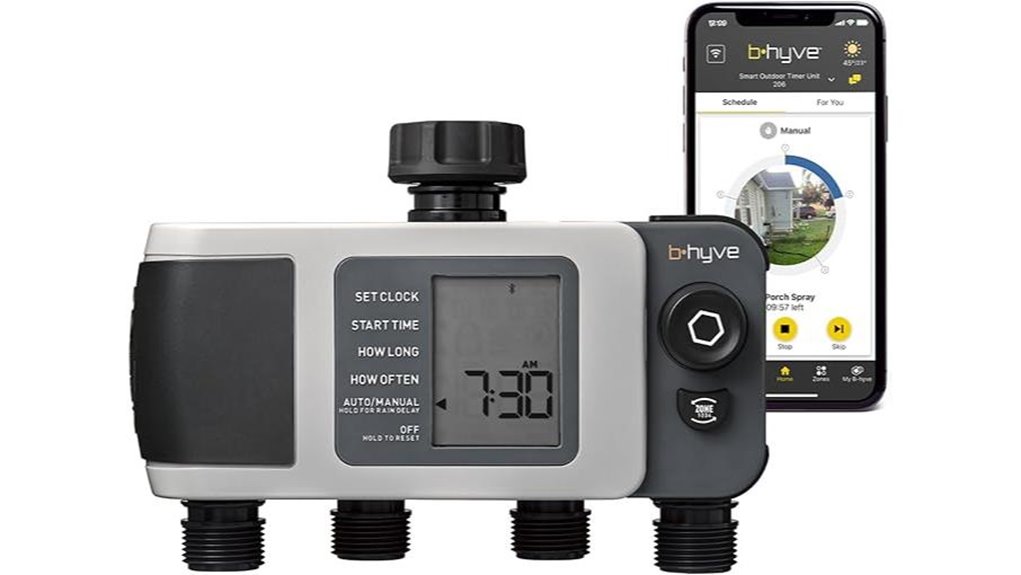
Orbit 24634 B-hyve XD 4-Port Smart Hose Watering Timer

orbit smart 4port timer

Looking to manage multiple hoses without juggling cords? The Orbit 24634 B‑hyve XD 4‑port timer lets you program each line via Wi‑Fi, Bluetooth, or its touch screen. It offers six adjustable settings—duration, frequency, etc.—and its 2.0 Hub syncs everything. The timer adapts to live weather, drought levels, and respects restrictions you set. Paired with a Wi‑Fi hub, it earns EPA WaterSense certification, cuts waste using hyper‑local data, and trims run time during dry spells. Made in plastic, it’s IPX‑5 waterproof, 1‑inch tall, 4‑inch screen, and only eight ounces. A 30‑day return guarantee and manufacturer warranty give you peace today.

Best For: homeowners who manage multiple hose lines and want automated, weather‑smart watering that cuts waste while respecting local restrictions.

Pros:

  • Intuitive multi‑port control via Wi‑Fi, Bluetooth, or touch screen
  • Adaptive scheduling that trims run time during droughts and uses hyper‑local weather data
  • EPA WaterSense certification (with Wi‑Fi hub) guarantees water‑saving performance

Cons:

  • Full WaterSense certification requires a separate Wi‑Fi hub, adding cost and setup steps
  • The compact plastic housing feels less premium than metal models
  • Warranty is only 30‑day Amazon return; extended support requires contacting Orbit directly.

https://www.amazon.com/dp/B0B1QWVQPY

Rain Bird MANIFRE6S Drip Irrigation 6-Port Manifold, Unregulated Free Flow

rain bird free flow manifold

If you’re building a drip network that serves up to six zones, the Rain Bird MANIFRE6S delivers a simple, unregulated free‑flow manifold that lets you hook six 1/4‑in. drip tubes straight to a single 1/2‑in. riser in minutes.

Made from plastic, it measures 1.43 × 1.21 × 2.5 inches and tolerates up to 40 psi, making it durable on lawns. Deployment is quick: attach the 1/2‑in. NPT top to your pressure‑regulated source, then thread the 1/4‑in. barbed outlets into drippers, emitters, or micro‑sprays. If you need underground pop‑ups, use the RCKIT‑1PS kit. With optional 1/4‑in. tees, you can expand each outlet to several devices, maximizing efficiency.

Best For: Small to medium drip irrigation networks that require a quick, unregulated, free‑flow manifold for up to six ¼‑inch water lines.

Pros:

  • Compact 1.43 × 1.21 × 2.5‑in. design saves space and simplifies installation.
  • UV‑ and chemical‑resistant plastic construction tolerates up to 40 psi, ideal for residential and small commercial lawns.
  • Self‑flushing barbed outlets reduce clogging and maintenance downtime.

Cons:

  • Requires a pressure‑regulated source; not suitable for true 100 % free‑flow systems.
  • Limited to six ¼‑inch outlets unless additional tees are used, which increases parts.
  • No adjustable flow setting—holds fixed at free flow, which may restrict fine‑tuned irrigation schedules.

https://www.amazon.com/dp/B003MZ1ESW

Smart WiFi Hose Timer, Alexa Compatible, 20 Plans

smart hose timer alexa compatible

For busy homeowners who want to keep their garden thriving without lifting a finger, the Smart WiFi Hose Timer is the perfect solution. It plugs into your hose, disappears without a visible cable, and connects via 2.4 GHz Wi‑Fi; if the hub goes offline, Bluetooth keeps it running within 60‑70 ft. Use the Smart Life app to view watering history, battery status, and weather‑delay alerts, and schedule 20 plans—from 10 normal to 10 soak‑cycle modes. Alexa and Google Assistant give hands‑free control, and four alkaline AAA cells last durably more than six months and trigger a low‑battery alert when below 20 %.

Best For: busy homeowners who want automated gardening.

Pros:

  • Seamless integration with Wi‑Fi and Alexa/Google Assistant for hands‑free control.
  • 20 programmable schedules, including dual‐mode soak cycles, enable precise watering.
  • Low‑power, battery‑driven design gives over six months of operation with a simple battery‑low alert.

Cons:

  • Requires 4 × AAA batteries (not included), adding recurring cost.
  • 2.4 GHz Wi‑Fi required; may struggle in areas with weak signals.
  • No independent power source, so must remain near a power outlet for battery replacement.

https://www.amazon.com/dp/B0F5Q887L8

RAINPOINT 2-Zone WiFi Water Timer & Sprinkler

dual zone wifi sprinkler timer

Need a smart irrigation hub that keeps your lawn lush while trimming your water bill?

With the HWG023 gateway, you’ll connect via 2.4 GHz Wi‑Fi, covering up to 250 m—good through several walls—and pair one unit with up to eight RAINPOINT sensors and valves.

The brass inlet, metal filter, and upgraded valve coil give you a 116 PSI‑rated, heat‑and‑sun‑resistant system that stays IP65 sealed, so you avoid leaks and extend lifespan.

Program up to six watering plans on two zones, choosing from normal, cycle‑and‑soak, or misting modes, and schedule odd, even, interval, or custom days.

Weather logic adds delays and drought boosts.

Best For: homeowners who want a compact, Wi‑Fi‑controlled irrigation system that can monitor multiple zones, adjust watering automatically for weather and drought, and integrate with smart‑home assistants.

Pros:

  • 2‑zone flexibility with up to 6 customized watering plans per zone.
  • Weather‑based rain delay and drought‑boost logic reduce water waste.
  • High‑precision ±5 % flow meter with 24‑hour monitoring and instant alerts.

Cons:

  • Requires a 2.4 GHz Wi‑Fi connection only—no 5 GHz support.
  • Limited to eight devices per gateway, which may be insufficient for larger properties.
  • 1‑year warranty, shorter than some competitors.

https://www.amazon.com/dp/B0G6D54SRF

Lumary WiFi Water Timer with Hub & Alexa

alexa enabled wifi water timer

Its hub plugs into your 2.4 GHz WiFi, letting you control everything from the Lumary app, an on‑demand button, or Alexa voice—no wiring or hard‑wiring needed. You pair the device via the app, then manage regular or cyclical schedules—five adjustable settings, start times no earlier than 00:05, and a 24‑hour shut‑off. Manual mode gives instant watering, while rain‑delay daily auto‑skips runs for 24, 48, or 72 h based on local weather data. The IP55‑rated hub powers through a USB gateway, ships at 6.4 oz, and supports two‑zone battery setups. With a 30‑day return policy and warranty, it keeps lawns healthy winter‑freeze risk.

Best For: homeowners who want easy, Wi‑Fi‑controlled lawn watering with voice integration and automatic rain‑delay weather adaptation.

Pros:

  • Convenient app and Alexa control for hands‑free scheduling.
  • Weather‑adaptive rain‑delay saves water and reduces maintenance.
  • Compact, lightweight design with 2‑zone battery flexibility.

Cons:

  • Requires continuous 2.4 GHz Wi‑Fi; no power in winter freeze conditions.
  • Limited to 24‑hour watering periods; no advanced scheduling depth.
  • Not fully submersible—only dust‑protected, not suitable for heavy spray.

https://www.amazon.com/dp/B0F2T8N2CQ

Orbit Adjustable Flow Drip Irrigation Manifold

orbit adjustable drip manifold

Whether you’re a container gardener or tending a tight‑tiled raised bed, the Orbit 67000 8‑port manifold lets you control each drip line with a quick twist—its adjustable flow dial fits every plant’s water needs while its compact 2‑in. Designed for point‑source spot watering, the manifold supports up to eight ¼‑inch drip lines and plugs straight into your existing 1/4‑in. tubing. Its 360° rotating barbs keep connections snug, while threaded caps shut unused ports, saving water. A quick‑access filter port lets you keep flow clean, and the manual flow dials pair nicely with Orbit’s B‑hyve smart controller for on‑demand scheduling.

Best For: small‑bed growers and container gardeners who need quick, adjustable water flow for multiple plants in tight spaces.

Pros:

  • Compact 2‑in. design fits easily into narrow beds or hosing spaces.
  • 360° rotating barbs keep ¼‑in. connections tight and reliable.
  • Adjustable flow dials and threaded caps allow precise, water‑sparing control for each line.

Cons:

  • Made of plastic, which can be less durable than metal manifolds.
  • Manual flow dials may lack the precision of pressure‑loss controllers.
  • Requires a separate pressure regulator and filter for optimal performance.

https://www.amazon.com/dp/B08SPZHKKZ

WiFi Smart Water Timer for Garden Hose

wifi smart water timer

Want to keep your garden thriving without lifting a finger? You’ll love the Insoma Wi‑Fi smart water timer. Plug it into your 2.4 GHz hub and control every outlet via the app, Alexa, or Google Assistant. Two coaxial ports let you set up to twenty watering programs—timed starts, durations, and odd‑or‑even weekly cycles—plus on‑demand, unlimited manual sessions. Rain‑delay pauses up to seven days and auto‑resumes. Scale the system to thirty‑two timers, share control with family, and enjoy brass plumbing fittings and a tiny 1.28‑lb body. Use it to cut water waste and boost plant health. Warranty backs the whole product.

Best For: homeowners with a garden who want hands‑free watering, voice‑controlled schedules, and the ability to scale to multiple zones.

Pros:

  • Dual outlets that support up to 20 watering programs and a rain‑delay feature that can pause watering for 1–7 days.
  • 2.4 GHz Wi‑Fi connectivity with a hub and app, plus Alexa and Google Assistant voice commands for effortless control.
  • Expandable to 32 timers from a single hub, family‑member sharing, brass plumbing fittings, and a lightweight 1.28‑lb body for easy installation.

Cons:

  • Limited to 2.4 GHz Wi‑Fi only—no 5 GHz or Bluetooth support.
  • Each device tops out at 20 programs; larger gardens may need additional hubs to reach the full 32‑timer capacity.
  • Requires a separate hub and manual plumbing connection, adding a small installation step compared to standalone models.

https://www.amazon.com/dp/B0DZGV78VJ

MOES 2‑Zone WiFi Sprinkler Timer with Hub

moes 2 zone wifi sprinkler timer

If you’re juggling two distinct garden zones, the MOES 2‑Zone WiFi Sprinkler Timer let’s you keep each area hydrated on its own schedule.

Tap the app to assign individual schedules to each brass inlet, or let the timer switch between zones automatically.

When rain arrives, your timer pauses watering for up to seven days, then resumes automatically.

Its IP55 rating guards against splashes, dust, and UV exposure, while a rubber gasket keeps internal water out.

Made from durable brass and pure copper, it endures 7.25–116 psi pressure and 40–113 °F temperatures.

Four AA batteries power this lightweight 0.4‑lb compact hub.

Best For: homeowners with two separate garden sections who want independent, app‑driven watering schedules and automatic rain delays.

Pros:

  • Dual‑zone control allows tailored watering for different plants or lawn areas.
  • Battery powered (4 × AA) for hassle‑free installation anywhere.
  • IP55 rating and brass/copper build ensure durability against weather and pressure.

Cons:

  • Limited to only two zones – not suitable for larger, multi‑zone gardens.
  • Requires separate WiFi/Bluetooth setup; may struggle in weak signal areas.
  • No explicit warranty duration listed; service support details unclear.

https://www.amazon.com/dp/B0GMVZW7M7

2-Zone WiFi Water Timer with Alexa Control

dual zone alexa water timer

Dreaming of a garden that waters itself? You’re in luck—the Zone WiFi Water Timer delivers on that promise. Its brass swivel inlet and gray housing resist sun and leakage, while the two outlets let you split the yard into independent zones. Connect it to Wi‑Fi and use the Smart Life app for scheduling, viewing, on‑demand watering. Alexa voice commands toggle the circuit instantly. With timed, cyclical, or manual modes, set start times, durations, week cycles, odd/even days, and rain delays up to seven days. One gateway supports 32 timers, and family members can join the app. Total settings: 42.

Best For: Busy homeowners who want fully automated, voice‑controlled irrigation for one or two garden zones.

Pros:

  • Durable brass swivel inlet resists sun, heat, and leaks for long‑term performance
  • Full Wi‑Fi scheduling via Smart Life app plus Alexa voice control for instant on/off
  • Flexible modes (timed, cyclical, manual) and up to 7‑day rain delay for variable weather

Cons:

  • Relies on a stable Wi‑Fi connection; no offline backup option
  • Limited to only two zones, so larger gardens need a separate gateway
  • Initial setup and configuration can be a bit involved for non‑tech users

https://www.amazon.com/dp/B0F6JRJ75S

RESTMO Smart Dual‑Zone Sprinkler Timer with Flow Meter

smart dual zone flow timer

Ever wonder how one device can keep both your front lawn lush and your backyard garden thriving without you juggling hoses? With RESTMO’s Smart Dual‑Zone Timer, you manage each zone separately through a Wi‑Fi app, even scheduling up to eight programs per zone for intervals, weekly, odd‑or even‑day waterings. Its flow‑metering feature records exact usage, auto‑shutting when pressure drops after 3 minutes, so you never over‑water your soil, while the brass connections and IP55 rating guarantee long‑term corrosion resistance. A one‑touch button lets you start watering for 1‑24 hrs, and rain‑delay settings pause the system for 72 hours during wet spells.

Best For: homeowners who need to water separate front and back yard zones simultaneously and want remote, rain‑delay, and flow‑metered control.

Pros:

  • Dual‑zone outlets let you run independent programs for lawns, gardens, or plant types.
  • Integrated flow meter records precise usage and auto‑shuts after 3 min if pressure drops.
  • Wi‑Fi + RF hub plus a one‑touch button give flexible on‑demand watering from anywhere.

Cons:

  • Supports only 2.4 GHz Wi‑Fi, limiting use with 5 GHz‑only routers.
  • Flow‑meter auto‑shut is not applied to soaker hoses, potentially under‑watering such systems.
  • Requires a separate RF hub; if the hub fails, the timer loses connectivity.

https://www.amazon.com/dp/B0F1S4SLVK

SONOFF Zigbee Sprinkler Timer – Alexa & Google Control

sonoff zigbee sprinkler timer

The SONOFF Zigbee Sprinkler Timer turns your garden into a smart sanctuary, letting you control watering schedules right from Alexa or Google Home—so any homeowner with a Zigbee hub can skip the manual hassle.

You attach it near your irrigation control and tap its buttons to pick one of five preset watering strengths. The body weighs 0.61 lb, spots. Via Zigbee, it plugs into your hub—Alexa or Google Home can start or adjust schedules with a command. Program gardens, lawns, or pools, cut water waste, and save effort. SONOFF offers a warranty, and reviews average 3.9 out of 5, showing value.

Best For: homeowners who own a Zigbee hub and want quick, voice‑controlled irrigation with minimal setup.

Pros:

  • Five programmable presets for effortless watering customization
  • Voice control via Alexa or Google Home for hands‑free scheduling
  • Compact, lightweight design that fits easily near irrigation control

Cons:

  • Requires a separate Zigbee gateway or hub
  • Customer rating only 3.9 / 5, indicating mixed user experience
  • Limited to five preset settings—no granular adjustment or app integration

https://www.amazon.com/dp/B0D5B8S8N8

Smart WiFi 2-Zone Hose Timer with Alexa

dual zone alexa wifi timer

If you want to water your lawn and greenhouse without ever stepping outside, the Smart WiFi 2‑zone hose timer gives you Alexa‑powered voice control and independent scheduling for each outlet. Tap the Smart Life app to set up two programs; each outlet supports up to five schedules. Choose irrigation or spray modes, tweak runtime and cycles. Control works via panel, while Alexa or Google Assistant can start, pause, or stop watering instantly. The IP55‑rated device has a 0.53‑kg plastic body and a 24‑72‑hour rain‑delay feature powered by weather data. Activity logs record each cycle’s start, duration, and end times.

Best For: Homeowners with small‑to‑medium lawns or greenhouses who want hands‑free, individually scheduled watering with voice control and weather‑based rain delays.

Pros:

  • Independent scheduling for each of the two outlets with up to five programs per outlet.
  • Alexa and Google Assistant integration allows instant start, pause, or stop via voice.
  • Weather‑enabled rain‑delay feature (24/48/72 h) and activity logs for precise tracking.

Cons:

  • Only two zones; not ideal for larger gardens requiring more outlets.
  • Built from plastic and rated IP55; might feel inexpensive and could be less durable.
  • Requires a stable 2.4 GHz WiFi connection and a Smart Life app; no local network fallback.

https://www.amazon.com/dp/B0D3TC568K

yolink smart sprinkler timer

For busy homeowners who demand precision watering, the YoLink Smart Sprinkler Timer (YS4103) lives up to its promise. Its IP66 design offers rugged, waterproof housing ideal for gardens, lawns, or small farms. You can choose Duration mode for fixed on/off times, Volume mode for exact water output, or ECO mode, which pauses during rain and resumes automatically. A built‑in flow meter tracks real‑time flow and total usage. LoRa connectivity works up to 400 m without Wi‑Fi; the hub bridges to cloud. With 180‑day history, you control everything via the YoLink app or a button for precise control and monitoring efficiency.

Best For: busy homeowners and small‑farm operators who want precise, weather‑aware watering without complex Wi‑Fi setup.

Pros:

  • IP66 waterproof design protects against harsh outdoor conditions.
  • LoRa connectivity allows up to 400 m range without Wi‑Fi, simplifying setup.
  • Built‑in flow meter and 180‑day history provide accurate usage tracking and data.

Cons:

  • Requires a separate hub for cloud access, adding cost and setup steps.
  • LoRa range may drop in heavily obstructed environments.
  • Limited firmware update options and no modular feature upgrades.

https://www.amazon.com/dp/B0G38D5QZY

Factors to Consider When Choosing Garden Irrigation Hub

You’ll want to check that the hub’s connectivity supports your home network and any existing smart devices so you can avoid compatibility headaches. Make sure the system lets you mix and match legacy irrigation controls or other smart home platforms, giving you flexible integration options. Also review its energy use, clear pricing, and how often firmware gets updated to keep the hub secure and efficient.

Connectivity Compatibility

Connectivity is the heart of a garden irrigation system, and picking a hub that matches your network matters. If your home router runs 2.4 GHz, a hub that only uses 5 GHz may cut off your water‑control range; choose a unit that covers 30–100 m in open space to match your yard. Look for support for several protocols—Bluetooth, Zigbee, Z‑Wave, or LoRa—because they’ll let you plug in any smart sensor and keep the network alive even when Wi‑Fi dips. A hub that caps linked timers at eight or sixteen limits future expansion; pick one that expands freely with just a single Wi‑Fi gateway. Keep firmware current via OTA, and opt for dual‑band Wi‑Fi or a Bluetooth fallback to guard against primary‑network hiccups for continued reliability through updates.

Integration Flexibility

Because a garden’s watering needs shift with seasons and sensor data, you’ll want a hub that doesn’t lock you into one protocol. Check that it speaks Wi‑Fi, Bluetooth, Zigbee, and LoRa; the more choices, the more sensors and smart home devices you can plug in. A high‑end model should expose an open API or webhook, letting you tie weather feeds or custom IoT data into your watering logic. If you need 32 separate zones, the hub should support that, allowing micro‑irrigation rigs to coexist with full‑garden sprinklers in one dashboard. Voice‑assistant compatibility also matters; the hub must expose standard skill interfaces so a simple “water the roses” command triggers instantly. Finally, flow‑metering and environmental inputs let you fine‑tune watering and override from your phone.

Energy Consumption

How much power will your garden hub swallow, and does that sit neatly under your energy budget? Even when idle, most hubs keep the draw below 0.5 W, and sleep mode cuts it to just a few milliwatts. A Wi‑Fi‑enabled model spikes to 1.5–3.0 W on active communication, but a 30‑minute duty cycle for routine updates keeps the average low. Battery timers using low‑power microcontrollers can survive six months or more on four AAA cells, thanks to power‑gating firmware. Switching from a wired source removes the 3–5 A surge, cutting instant loss. Mesh‑networked hubs share under‑200‑byte packets, keeping network traffic—and therefore extra energy—negligible. If you use solar panels, those bulbs can even regenerate power during daylight, ensuring your system stays self‑sufficient year after year. So easily, noticeably.

Cost Transparency

While that tiny power consumption keeps your monthly bill down, the real budget impact comes from the hub’s upfront and ongoing costs.

You’ll pay between $xx for the base unit and additional $25‑$45 for each extra valve you add.

Subscription tiers are billed monthly, ranging from $5 to $15, enabling real‑time weather data and advanced reports that help you diagnose problems early.

A professional install may sneak in an extra $10‑$20 fee per extra zone for wiring and regulation, so plan ahead.

Extend warranty can add $50‑$70, covering sensor failures; a full‑coverage plan saves you long‑term by reducing repair expenses.

Firmware Updates

When you pick an irrigation hub, you’ll want its firmware updates to ship over the air—so the system stays fresh without you having to lift a finger. Check the version history; a recent update date and a high patch count usually signal a vendor that actively maintains the device. Notice if the logs publicize CVE fixes—this transparency proves you’re not stuck with unpatched security holes. During OTA, the firmware should support graceful rollbacks or a golden image, letting you bounce back if a new version skids. Finally, verify that updates preserve API compatibility or clearly document how legacy devices should migrate, so your smart sprinklers stay connected for years. With these safeguards, you’ll enjoy uninterrupted, secure irrigation without tedious manual tweaks all around today.

Frequently Asked Questions

Can the Irrigation Hub Be Retrofitted Into an Existing Irrigation System?

Yes, you can retrofit a hub into your existing irrigation system. First, shut off your water supply and drain the line. Then, flush the system to remove debris so you can install the hub’s inlet fittings. After adding the hub, reconnect all downstream valves, adjusting flow so each zone receives proper pressure. Finally, run a test, tweak settings, and you’ll enjoy efficient, automated watering. And intelligently manage resources, saving both time and money.

What Maintenance Tasks Are Required for Long‑Term Hub Reliability?

Don’t dismiss routine checks as a waste of time; actually, neglecting them shortens your hub’s lifespan. Start by inspecting filters; you clean or replace them monthly. Check for leaks at connections, tighten valves, and replace corroded fittings. Test solenoids and valve actuators weekly, ensuring full open/close cycles. Monitor set pressures daily, calibrate sensors, and document changes each season. Finally, verify wiring integrity and replace properly any frayed conductors promptly today.

Does the Hub Support Manual Overrides During Power Outages?

Yes, you can manually override the hub when power fails. Switch the control panel to manual mode, and use the bypass switches to keep your irrigation running. The built‑in relay will let you maintain zone pressure, so your garden stays hydrated even when the grid goes down. You’ll remember to reset to automatic once electricity returns, and your system stays reliable. This feature saves you hassle during stormy weather too.

Can One Hub Control Both Hose and Sprinkler Zones Simultaneously?

Imagine this: your backyard turns into a symphony of water, and you’re its bewildered conductor. Yes, one hub can manage both hose and sprinkler zones simultaneously, letting you water the lawn, the driveway, and the random pumpkin patch all at once. Just hit the smart panel, and revel in the absurd efficiency—no more juggling hoses or buying extra controllers for each sprinkler whizbang. Water, you win the joy for you.

What Is the Battery Life of a Typical Smart Irrigation Hub?

Most smart irrigation hubs run on a rechargeable 18650 or 9V battery and last about 2‑6 months between charges, depending on usage and weather sensors. Some models include a solar panel, extending life to nearly a year. If you replace standard AA packs, expect roughly 6 weeks of operation at moderate watering schedules. Keep an eye on battery percentage to avoid shutdown and plan your recharge accordingly for uninterrupted watering away.

Conclusion

By choosing a Wi‑Fi‑enabled hub, you cut water waste, save on bills, and free time for garden fun. In a backyard in Boise, the H2Ohub Smart Timer synced with Alexa, reducing runoff by 30% during the first three months. You’ll enjoy precise schedules, remote tweaking, and seasonal alerts—all from your phone. The future of garden care is easy, efficient, and sustainable. Let the hub transform your watering routine today and bring the community garden vibrancy back.

Best Garden Irrigation Hub Every Backyard Needs

Your garden deserves the smart, weather‑responsive Orbit B‑hyve XD 4‑Port hub. It turns any standard hose into a 4‑zone watering system, syncs with Wi‑Fi and Bluetooth, and automatically adjusts schedules based on local data. Dry‑run detection and leak monitoring protect your budget. It works inside homes or outdoor decks, and its compact design keeps the garden looking sleek. This tool saves water and effort, and you’ll discover how it fits any backyard for every season.

Key Takeaways

  • Look for a hub that supports at least 4–8 zones for full garden control, as limited zones restrict expansion.
  • Ensure the hub offers weather‑based auto‑delay and drought adjustment to conserve water and avoid over‑watering.
  • Prefer hubs with robust IP55/65 waterproofing and durable brass fittings to survive outdoor conditions and reduce maintenance.
  • Check for dual Wi‑Fi/Bluetooth or local control for reliability, and ensure the app supports remote scheduling and battery alerts.
  • Evaluate integration with smart assistants (Alexa, Google Home, IFTTT) and flow‑metering for real‑time usage data and leak detection.

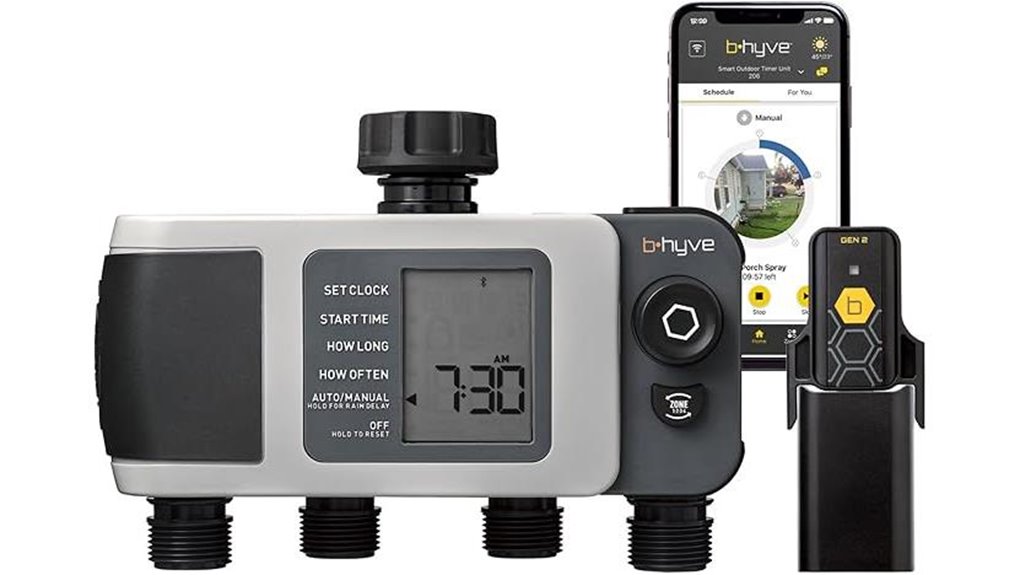
Orbit 24639 B-hyve XD 4-Port Smart Hose Watering Timer with Wi-Fi Hub

orbit 4 port smart timer

If you’re looking to give each part of your garden the exact amount of water it needs—no over‑watering and no waste—our 4‑port Orbit B‑hyve XD timer with Wi‑Fi hub is the perfect fit. You’ll get precision, adjusting flows with weather data so each zone receives right volume. The hub lets you control via Wi‑Fi or locally via Bluetooth, and it plugs into ecosystems. Automatic drought adjustment scales usage based on regional indices, while WaterSense certification guarantees efficiency. IPX‑5 waterproof, 9.75‑in deep and 4.62‑in high, it’s lightweight at 2.2 lb and durable plastic, with a 30‑day return and manufacturer warranty.

Best For: homeowners with multiple garden zones who want precise, weather‑responsive irrigation without manual scheduling.

Pros:

  • Dual‑mode connectivity lets you control the system via Wi‑Fi hub or local Bluetooth, ensuring flexibility.
  • Hyper‑local weather integration and automatic drought adjustment cut water usage by scaling irrigation to real‑time conditions.
  • IPX‑5 waterproof rating and compact, lightweight design make it durable and easy to install.

Cons:

  • Requires the additional Wi‑Fi hub attachment for full functionality, adding cost and setup steps.
  • Dependence on Internet connectivity for remote control can be problematic in areas with weak signals.
  • The single-color plastic case may not appeal to those looking for a more premium aesthetic.

https://www.amazon.com/dp/B09KJZKVNS

RAINPOINT WiFi Water Timer for Garden Hose

rainpoint wifi hose timer

Looking for a hassle‑free way to turn a garden hose into a data‑driven irrigation system, the RAINPOINT WiFi Water Timer delivers with its two‑zone, WiFi‑enabled design and IP65‑sealed housing that keeps moisture and heat from ruining your setup. Position it between a 5.6 D × 3.2 W × 7.4 H plug‑in and your hose, and the brass inlet and outlet handle 116 PSI water with a metal filter to thwart clogs. The antenna gateway HWG023 extends 250 m reach, bouncing through walls and pairing up to eight devices. You can program six watering plans, choose from Normal, Cycle & Soak, or Misting, and set daily, even, interval, or custom schedules.

Best For: homeowners who need a simple, Wi‑Fi‑enabled irrigation solution for a garden hose or small patio setup, with flexible zone control and smart scheduling.

Pros:

  • Dual‑zone control with up‑to‑250 m Wi‑Fi reach via the HWG023 gateway.
  • Brass inlet/outlet and metal filter resist heat, sunlight, and clogging, handling 116 PSI water.
  • Weather‑based auto‑delay and seasonal adjustment keep watering efficient and water‑wise.

Cons:

  • Only two zones, limiting larger or multi‑area irrigation needs.
  • Requires a separate gateway device (HWG023) and a stable home Wi‑Fi network.
  • No battery backup; depends on continuous power supply.

https://www.amazon.com/dp/B0G6D54SRF

RESTMO Smart Sprinkler Timer with Flow Meter

restmo flow metered sprinkler timer

When you need precise water control to meet strict water‑use regulations, the RESTMO Smart Sprinkler Timer with Flow Meter gives you that exact flexibility. Connectivity is simple: a 2.4 GHz Wi‑Fi hub lets you manage it from the Smart App or a one‑touch button. It supports manual watering up to 24 hrs and offers rain‑delay options of 24, 48, or 72 hrs. Water management is top‑notch. Set exact volume modes and monitor daily, weekly, monthly, or yearly usage. A built‑in flow meter automatically shuts off after three minutes if pressure dips, conserving water—perfect for low‑pressure systems. Enjoy corrosion‑resistant, leak‑proof brass parts forever.

Best For: Homeowners and small commercial growers who need precise, Wi‑Fi‑controlled irrigation to comply with strict water‑use regulations and maintain sustainable watering practices.

Pros:

  • Built‑in flow meter provides exact volume control and real‑time monitoring, reducing water waste.
  • Flexible scheduling (interval, weekly, odd/even day) with up to 8 independent zones per controller.
  • Durable brass/plastic construction and IP55 rating make it weather‑proof and long‑lasting.

Cons:

  • Only 2.4 GHz Wi‑Fi support may limit connectivity in environments that rely on 5 GHz networks.
  • The 3‑minute low‑pressure shutdown may cut short watering for some low‑pressure systems like certain soaker hoses.
  • Manual watering is capped at 24 hours, which could be restrictive during extended irrigation needs.

https://www.amazon.com/dp/B0F1LKWNK4

RAINPOINT WiFi 4-Zone Garden Sprinkler Timer

rainpoint wifi 4 zone timer

The RAINPOINT WiFi 4‑Zone Garden Sprinkler Timer lets you automate your yard with just a tap on your phone—ideal for homeowners who want hands‑free, precise watering. Equipped with a 4‑zone Wi‑Fi system, you can schedule up to five watering frequencies—daily, weekly, odd, even, or custom—and toggle between Normal, Interval, or Cycle & Soak modes. Each zone runs sequentially, so you never worry about overlapping cycles. A single‑zone override via the app lets you address urgent patch needs instantly. Place the HWG023BRF high for 492‑ft coverage; weather triggers skip watering, and a long‑press button offers a quick 10‑minute burst daily emphasis.

Best For: homeowners who want a DIY Wi‑Fi sprinkler system for up to four garden zones with weather‑aware automation.

Pros:

  • Powerful 492‑ft Wi‑Fi range from the HWG023BRF gateway for reliable remote control.
  • Flexible scheduling with five watering frequencies and three distinct modes (Normal, Interval, Cycle & Soak).
  • Smart weather triggers, manual 10‑minute bursts, and app‑based single‑zone overrides for precise, hands‑free watering.

Cons:

  • Supports only four zones, limiting scalability for larger lawns.
  • Requires elevated placement and strong Wi‑Fi; no offline mode or built‑in backup power.
  • No built‑in battery backup, so power outages could halt watering until power is restored.

https://www.amazon.com/dp/B0G4246MTN

Lumary WiFi Water Timer for Hose with Alexa

alexa enabled lumary hose timer

Want a smart watering system that keeps your plants hydrated while you’re traveling? The Lumary WiFi Water Timer for Hose with Alexa lets you control watering from anywhere. Pair your hub to 2.4 GHz Wi‑Fi with the free app, then add the sprinkler timer in one click. Alexa voice commands and manual on‑demand modes give you flexibility, while six scheduling options—regular, rain delay, pause, and custom cycles—ensure precise water delivery. Its brass inlet and IP5 5 rating endure sun and dust, and its low‑power mode saves electricity. Compact orange design, 6.4 oz, fits any garden setup. Enjoy sustainable, hassle‑free irrigation today.

Best For: homeowners who want a hassle‑free, weather‑adaptive watering system that can be controlled from their phone or voice at any time.

Pros:

  • One‑click Wi‑Fi pairing and Alexa voice control for effortless remote management.
  • 6‑mode scheduling (rain delay, custom cycles, pause, etc.) ensures precise water delivery and saves water.
  • Robust construction (brass inlet, IP55 rating) gives lasting durability in sunny, dusty garden environments.

Cons:

  • Only supports 2.4GHz Wi‑Fi, so 5GHz networks are incompatible.
  • Requires disposable AA batteries (2 × AA for single‑zone, 4 × AA for two‑zone) – not rechargeable.
  • Not usable in winter when water can freeze; limits continuous year‑round operation.

https://www.amazon.com/dp/B0F2T8N2CQ

Rachio Smart Hose Timer with WiFi Hub

rachio wifi hose timer

If you’re a homeowner who wants to cut watering time and conserve water, the Rachio Smart Hose Timer with WiFi Hub lets you control up to eight irrigation zones while automatically skipping rain and alerting you to leaks. The Rachio SHVK001 kit ships one valve, a hub, and power supply. Pair the hub, schedule or run zones via the app or voice services Alexa, Google Home, or IFTTT. Valves use two AA batteries; the hub powers them and monitors flow for leaks and low battery. Expandable to eight valves, system includes a 6‑inch display and a 2‑year limited warranty.

Best For: homeowners who want an affordable, Wi‑Fi‑controlled irrigation system that reduces water waste, skips rain, and alerts them to leaks.

Pros:

  • Up to 8 zones managed from a single 2.4 GHz Wi‑Fi hub, all without tools.
  • Built‑in rain‑skip, flow monitoring, and low‑battery alerts keep water use efficient and solve leaks early.
  • Voice integration (Alexa, Google Home, IFTTT) plus a 6‑inch hub display make scheduling quick and accessible.

Cons:

  • Two AAA batteries per valve are required and not supplied, adding an ongoing cost.
  • Hub operates only on 2.4 GHz Wi‑Fi, which can limit connectivity on dual‑band or 5 GHz‑only networks.
  • The 2‑year limited warranty applies only in the U.S. and Canada, leaving overseas buyers without coverage.

https://www.amazon.com/dp/B0BWXZWJ1C

Orbit 67000 8 Port Adj Flow Drip Manifold, Single

orbit 8 port drip manifold

Need a compact, highly adaptable drip manifold that lets you independently control up to eight emitter lines?

The Orbit 67000 model, long‑sleeved and lightweight at just over 13 g, snaps onto ½‑in. PVC risers and ¼‑in. barb fittings. Its eight ¼‑in. ports let you run single or adjustable‑flow lines, and the 360° rotating barbs make placement a breeze. Compatible with non‑pressure‑compensating emitters, micro‑sprinklers, or pressure‑sized tubing from Orbit, Hydro‑Rain, or other major brands. You’ll want a 120‑mesh filter or regulator to keep debris out. Ideal for beds, containers, trees, shrubs, or replacing spray heads. and any project for precise control.

Best For: gardeners looking to efficiently water flower beds, containers, and small trees with independent control of up to eight drip lines.

Pros:

  • Lightweight, compact design (13 g) for easy handling and storage.
  • 360° rotating barbs simplify installation and placement.
  • Adjustable‑flow ports allow precise water delivery and compatibility with a variety of emitter types.

Cons:

  • Requires compatible ¼″ barb fittings and an additional ½″ PVC riser for mounting.
  • No built‑in filter; a separate filter or regulator is needed.
  • Limited to ½″ PVC riser connections, restricting use on other pipe sizes.

https://www.amazon.com/dp/B000H9AI9C

Rain Bird MANIFRE6S Drip Irrigation 6-Port Manifold, Unregulated Free Flow

rain bird 6 port manifold

Because you’re looking for a reliable way to split a single water source into multiple drip lines, the Rain Bird MANIFRE6S manifold lets you attach up to six 1/4″ drip tubes to a single 1/2″ riser while keeping flow pressure unregulated and free‑flow. The 1.43 × 1.21 × 2.5‑inch body fits snugly atop your riser, and its six barbed outlets accept any 1/4″ tubing—drippers, emitters, bubblers, micro‑sprays—and flush itself, minimizing clogs. Because it runs on water power only and tolerates up to 40 psi, you can plug it straight into your pressure‑regulated source without adding valves—just connect, tighten, and watch water perform at once.

Best For: residential and small commercial growers who need a simple, low‑maintenance way to split a single water source into multiple drip lines.

Pros:

  • Unregulated free‑flow design eliminates the need for pressure‑regulating valves
  • Self‑flushing barbed outlets reduce clogging and maintenance
  • Compact 1/2″ riser interface fits most existing irrigation setups

Cons:

  • Requires matching 1/2″ riser, limiting compatibility with non‑standard fittings
  • No built‑in pressure regulation—may cause over‑pressure in high‑pressure systems
  • Only handles 1/4″ tubing, limiting use with larger applicators

https://www.amazon.com/dp/B003MZ1ESW

Orbit 90204Z B-hyve Gen 2 Smart Hose Watering Timer with Wi-Fi Hub

smart wi fi hose timer

Its gray plastic shell, weighing just 0.77 lb, is easy to reposition. Built‑in Wi‑Fi links securely to your network, syncing with Alexa, Google Assistant, and Apple HomeKit everywhere. The timer offers three water‑depth settings for precise control. Schedule weekly or seasonal routines through the user‑friendly app, and let the system auto‑adjust for rain. A 2‑year warranty backs it, plus Amazon’s standard return policy today.

Enjoy peace‑of‑mind; your irrigation stays consistent while away.

Best For: Home gardeners, landscapers, and smart‑home enthusiasts who want automated, precision watering without manual effort.

Pros:

  • Seamless Wi‑Fi hub integration with Alexa, Google Assistant, and Apple HomeKit for remote control.
  • Three programmable water‑depth settings and auto‑rain compensation for precise irrigation.
  • Lightweight gray plastic design and 2‑year warranty provide ease of use and peace of mind.

Cons:

  • Relies on a stable Wi‑Fi connection; no backup power if the hub is disconnected.
  • Limited to only three water‑depth levels—no granular control for advanced irrigation needs.
  • Requires initial setup via the mobile app, which can be daunting for non‑tech users.

https://www.amazon.com/dp/B0CGYVMR52

MOES WiFi 2-Zone Sprinkler Timer

moes 2 zone wifi timer

Dual‑zone control lets you manage your flower beds and lawns separately, so whether you’re watering a vibrant vegetable patch or a sprawling lawn, each area follows its own tailored schedule. The MOES timer blends brass and copper components with a polycarbonate shell, IP55 rating, and a 1‑inch frame that keeps water out even at high temperatures. Use the app to set timed or cyclical cycles, trigger manual bursts, or apply a 1‑to‑7‑day rain delay. It runs on four AA batteries, so you can water from anywhere without worrying about power cords. Compatible with 7.25‑116 psi faucets, it delivers two outputs.

Best For: homeowners who want to effortlessly manage multiple irrigation zones (like lawns, flower beds, or vegetable plots) from their phone and schedule them independently.

Pros:

  • Dual-spec brass and copper construction offers durable, long-lasting performance.
  • Wi‑Fi and Bluetooth connectivity lets you control watering schedules and manual bursts anywhere.
  • 4 × AA battery power provides cordless flexibility for outdoor use.

Cons:

  • Requires 7.25–116 psi water pressure, which may not suit all faucets or setups.
  • IP55 rating is only dust‑sensitive protection, not fully waterproof for sub‑mersible use.
  • Rain‑delay is limited to a 7‑day window, which may not cover extended weather events.

https://www.amazon.com/dp/B0GMVZW7M7

Orbit 67030 Drip Irrigation 2-Port Full-Flow Manifold

orbit 67030 2 port drip

If you’re looking to give trees, shrubs, and pots precise, effortless irrigation, the Orbit 67030’s 360° rotating barbs let you attach tubing in seconds—no tools required. It’s a compact 1 × 3.5 × 5.75‑inch black‑plastic manifold that plugs straight into any ½‑inch riser, giving you two ¼‑inch ports for versatile drip or spray use. Because both ports operate at full flow, you get consistent output even on uneven tubing lengths, making maintenance a breeze—no clog‑prone filters needed. Its 360° barbs rotate, so you can install from any angle, while the durable construction tolerates cold water and shuts off debris with minimal wear every season.

Best For: gardeners and landscapers who need a quick, low‑maintenance, two‑port drip manifold for trees, shrubs, or planters that plugs directly into standard ½‑inch risers.

Pros:

  • Rapid, tool‑free installation with 360° rotating barbs.
  • Dual ¼‑inch ports provide consistent output without clog‑prone filters.
  • Durable black‑plastic construction resists cold water and seasonal wear.

Cons:

  • Only offers two ports; larger irrigation plans require multiple units.
  • No built‑in flow control—requires separate pressure regulator for precision.
  • Designed for non‑pressure‑compensating emitters; may not suit all emitter types.

https://www.amazon.com/dp/B000H97F2U

WiFi 2-Zone Sprinkler Timer 984 ft Range

wifi 2 zone sprinkler 984ft

With a 984‑foot Wi‑Fi range, the Garden Irrigation Hub lets you control your garden from anywhere in your yard or a distant patio. You pair it with Bluetooth once, then sail over 300 m of reliable 2.4 GHz Wi‑Fi, far beyond rivals’ 15 m. The Smart Life or Tuya app, plus Alexa and Google, give you full command—label zones, set 1‑minute to 24‑hour programs, and slot five schedules or misting. Rain delay spans seven days, while manual presses refill pools or wash cars. Logs track every run, and recirculating mode offers gentle misting. Its orange plastic body weighs 0.96 lb and fits 4.52×2.08×4.96 in. Warranty and pro support back you.

Best For: gardeners and landscapers who need reliable long‑range Wi‑Fi control of multiple irrigation zones, from a distance or across large yards.

Pros:

  • Robust 984 ft wireless range ensures coverage beyond traditional 15 m limits.
  • Dual‑zone capability with 5‑program slots, misting option, and recirculating mode for nuanced watering patterns.
  • Voice, app, and manual controls backed by detailed logs and weather‑responsive rain delay.

Cons:

  • Requires 2.4 GHz Wi‑Fi setup; may need a separate network if 5 GHz‑only routers dominate your home.
  • Plastic construction can feel less premium than metal alternatives.
  • Initial Bluetooth pairing is necessary before full Wi‑Fi operation.

https://www.amazon.com/dp/B0DWSGD1XZ

Orbit Med-Area Auto Watering System with B-hyve Hub

orbit med area b hyve hub

Looking for a simple, all‑in‑one watering solution for a yard up to 1 250 sq ft? You’ll love Orbit’s 50022 kit, which turns any hose into a smart irrigation system. With the B‑hyve timer and Wi‑Fi hub, you program run times, set intervals, and trigger rain‑delay right from your phone. Six gear‑drive heads deliver head‑to‑head coverage, cutting dry spots and ensuring uniform watering. The patented Blu‑Lock tubing makes connections 80 % faster and 25 % stronger, while the weather‑proof timer keeps running all year. The kit includes everything you need—fittings, heads, and step‑by‑step instructions—so you’re up and watering in minutes, for your garden workflow.

Best For: homeowners with a 1,250‑sq‑ft yard or garden who want an easy, Wi‑Fi‑enabled irrigation system that turns a standard hose into a smart, rain‑delay‑able watering solution.

Pros:

  • All‑in‑one kit with B‑hyve smart timer and Wi‑Fi hub – install in minutes, no buried line required.
  • Head‑to‑head coverage from six gear‑drive heads eliminates dry spots and ensures uniform watering.
  • Patented Blu‑Lock tubing and 25 % stronger connections provide fast, leak‑free hookups and lasting durability.

Cons:

  • Limited to one zone and a maximum of 1,250 sq ft—doesn’t scale for larger yards.
  • Requires a constant power source for the hub and timer; if the Wi‑Fi signal is weak, connectivity may be unreliable.
  • The kit’s weatherproof timer and components are a bit pricier than basic DIY hose attachments, which could be a hurdle for budget shoppers.

https://www.amazon.com/dp/B07QS5J3F4

Rain Bird 32ETI DIY Self Install In-Ground Automatic Sprinkler System Kit

diy in ground sprinkler kit

The Rain Bird 32ETI kit is the go‑to choice for homeowners who want a quick, self‑installing irrigation system that covers up to 3,000 sq ft.

You dig trenches, grab the 125‑ft ½‑in tubing, and clamp 6‑inch threaded fittings and 2‑½‑in T’s that snap together without superglue.

Install six 32SA pop‑up heads and Rain Curtain nozzles; they rise four feet, spray a 40°–360° curtain, and resist wind.

The 1ZEHTMR hose‑end timer lets you program two daily sessions, set a 96‑hour rain delay, and cancel on demand.

Powered by two AA batteries, the kit delivers 12 GPM at 45‑75 psi, covering up to 3,000 ft² today.

Best For: homeowners who want a quick, cost‑effective DIY sprinkler setup for medium‑size lawns up to 3,000 sq ft.

Pros:

  • Rapid, tool‑free installation with snap‑together fittings and simple trench layout.
  • Wind‑resistant Rain Curtain nozzles that deliver a uniform, four‑foot‑high spray zone.
  • Programmable hose‑end timer offers two daily programs, a 96‑hour rain delay, and instant‑on/off flexibility.

Cons:

  • Batteries (2 AA) are not included, adding a small extra cost and requiring periodic replacement.
  • Requires a 45‑75 psi water supply; pressure fluctuations can affect head performance.
  • The unabridged manual may be dense for beginners, leading to a steeper learning curve.

https://www.amazon.com/dp/B00K72WU3Q

Sonoff Zigbee Sprinkler Timer for Alexa

alexa compatible zigbee sprinkler timer

If you want to free up your mornings from manual watering, the Sonoff Zigbee Sprinkler Timer turns voice‑activated control into the simplest part of your garden routine. Installed behind your existing valve, it weighs just 0.61 lb—light as a feather—and fits snugly within a 9.9‑inch depth, 2‑inch width, and 7.5‑inch height, all in sleek black plastic. Pair it with a Zigbee gateway to enable Alexa and Google Home voice commands, plus five preset schedules that handle everything from early‑morning mist to late‑afternoon deep soak. The 12‑month warranty gives peace of mind, and customer support is ready to help fix hiccup.

Best For: homeowners who want a hands‑free, voice‑controlled irrigation system that fits neatly behind existing valves and offers quick pre‑set scheduling for their garden or lawn.

Pros:

  • Voice‑activated control via Alexa or Google Home (through Zigbee)
  • Compact, lightweight design (0.61 lb) that easily fits within limited valve space
  • Five built‑in preset schedules for automated watering timing

Cons:

  • Requires a separate Zigbee gateway to operate
  • Limited to only five preset schedules, no custom schedule options
  • No standalone mobile app—management is only through the gateway interface and voice assistants.

https://www.amazon.com/dp/B0D5B8S8N8

Factors to Consider When Choosing a Garden Irrigation Hub

Consider whether the hub offers Zigbee, Wi‑Fi, or Bluetooth options and how far it can reach. Look for weather‑based scheduling and water‑saving integrations that adjust based on soil moisture and local rainfall. Make sure it works with your existing valves and that its mobile app is intuitive and easy to set up.

Connectivity Options and Range

Because your garden can span uneven terrain, deploying a hub with dual‑mode connectivity guarantees control even when your home router hiccups. Wi‑Fi runs from 30 to 60 m on clear paths, but walls shrink that to 10–20 m. Bluetooth hops everywhere, so you can tweak settings right at the sprinkler even if the router is down. A dedicated gateway claims 150 m line‑of‑sight, traverses 3–4 walls, and performs best when raised 3–5 m from the ground. If you need even farther reach, mesh‑enabled hubs double that range to about 300 m by relaying through compatible nodes, though each hop cuts bandwidth a little. Upgrading to Wi‑Fi 5 or Wi‑Fi 6 boosts data rates, but range stays similar to 2.4 GHz and older routers might not support them. Choose hub matching your range.

Weather‑Based Scheduling Features

You already know how connectivity keeps your sprinkler system alive, but weather‑based scheduling takes care of the rest. With an automatic postpone feature, the hub checks incoming rain forecasts and shifts the next watering up to 30 days, depending on severity, so you never over‑water after a storm. It also listens to a drought index, adjusting output between 10 % and 200 % to match current moisture needs. Seasonal adjustment modules let you scale preset durations from 10 % to 200 % each month, reflecting plant growth cycles. Integrated services trigger instant rain‑skip logic that stops or shortens runs when precipitation hits, cutting waste while protecting foliage. Real‑time feeds supply hourly updates, so each zone gets the exact amount of water for ideal health. Enjoy greener lawns and confidence knowing your garden adapts.

Water‑Saving Integration Capabilities

When choosing a garden irrigation hub, the most critical factor is how well it integrates real‑time weather data to adapt your watering schedule. It lets you skip days when rain is forecast up to 30 days ahead and ramps up flow during droughts. An embedded flow meter gives ±5 % accuracy, logging daily to annual consumption and firing alerts if you overshoot. The system pauses irrigation for 1–7 days with instant leak alerts, keeping wasted water at bay. Its drought‑index algorithm tweaks volume or frequency by up to 200 % based on regional data or your set threshold. Plus, a low‑pressure safety shut‑off stops flow after three minutes of low pressure, preventing over‑watering and saving water. You’ll keep irrigation efficient and waste minimal every time daily.

Compatibility With Valves

Did you know that a single mismatched port can turn a sleek irrigation hub into a leaking mess? When you line up valves, check the fittings first. Most hubs use ½‑in. NPT or ¼‑in. barb ports. A thread mismatch will either leak or outright fail to attach. Next, match pressure ratings. Most irrigation valves work at 20–70 psi. If your hub pushes higher pressure, the valve may seal poorly or rupture. Also, power is critical: 4‑way solenoids on smart hubs need 16–20 V DC. If you try a 120 V AC valve, the hub won’t control it. Finally, confirm flow meets zone needs. A valve should deliver 1.5–3 GPM per zone. A smaller valve may trigger the hub’s pressure‑sensing shut‑off early, stopping watering before the job’s done. It matters.

Mobile App Usability

What makes a mobile app indispensable for managing a garden irrigation hub? You’ll notice a touch‑friendly interface that stays responsive whether you connect over 2.4 GHz Wi‑Fi or Bluetooth, so pairing and firmware updates happen in seconds. Real‑time flow and usage graphs let you see exact gallons or liters per zone and follow 30‑day and yearly trends without guessing. Built‑in weather‑delay logic automatically skips watering when forecasts predict rain or when humidity crosses a user‑defined threshold, so you stay eco‑friendly and efficient without adding manual steps. Push notifications alert you to valve errors, low battery, or water‑budget milestones, and you can forward these alerts via email or text if you wish. One‑tap overrides and a drag‑and‑drop scheduler give you control and multiple programs per zone.

Durability And Weatherproofing

Because you’ll rely on your irrigation hub to keep your garden watering reliably in all conditions, you need a unit that’s truly weather‑proof.

An IPX‑5 rating tells you the hub survives low‑pressure water spray from every direction, so rain or mist won’t fry its electronics. If you work in dusty or humid conditions, look for an IP55 rating that blocks dust and high‑pressure jets, guaranteeing performance. Brass inlet and outlet fittings resist corrosion and can handle pressures up to 116 psi, keeping leaks at bay even in setups. A built‑in metal filter traps debris, cutting downtime by reducing clog buildup and extending maintenance intervals. Finally, a robust plastic chassis with rubber sealing gaskets shields circuitry across temperatures roughly 40 °F to 113 °F, keeping your hub running.

Smart‑Home Integration

If you want your sprinkler system to answer a voice command or trigger from your phone, you’ll need a hub that embraces modern connectivity.

Choose one that runs on 2.4 GHz or higher, uses encrypted Wi‑Fi, and plugs into Alexa, Google Assistant, Apple HomeKit.

Make sure the device exposes an open API or cloud service so you can build automations, sync calendars, and integrate third‑party apps.

An OTA‑update capable firmware keeps your hub secure and future‑proof, letting you add new features without replacing hardware.

Instant push notifications and real‑time event logs let you monitor valve status, water use, and weather‑triggered changes right from your dashboard.

Finally, look for Bluetooth or Zigbee support so the hub stays online if Wi‑Fi drops or you add valve modules.

Frequently Asked Questions

How Much Water Savings Does a Smart Hub Provide Annually?

You’ll typically save about 30 % to 50 % of your irrigation water each year—roughly 5,000 to 10,000 gallons, depending on your yard’s size and local climate. The hub adjusts sprinklers in real time, cutting runs when rain or moisture already is present. It also helps avoid overwatering during rainfall, meaning you use only what your plants truly need. By doing so, you cut maintenance time, reduce costs, and keep garden greener.

Does the Hub Support Integration With Home Automation Systems Like Home Assistant?

Yes, the hub works smoothly with home automation platforms like Home Assistant, letting you control irrigation schedules, set rain delays, and monitor water usage—all directly from your dashboard.

It’s equipped with built‑in MQTT support, letting you trigger water cuts when weather sensors report rain.

Plus, you can create automation rules for your smart plugs and lights, turning your garden into a fully integrated, eco‑friendly system and saving costs today.

What Is the Maximum Rainfall Detection Rate Threshold for Auto Shutoff?

A picture is worth a thousand words, and think of a gauge climbing until it hits its mark. You’ll see the hub auto‑shuts when rain reaches 125 mm/h, ensuring no wasteful watering. If the rate climbs higher, the system pauses until levels drop, protecting your soil from saturation. You can tweak this limit in the app, but 125 mm/h is safe for most gardens. It saves time, money, and protects plants daily.

Can I Use a Solar Panel to Power the Hub?

Yes, you can use a solar panel to power the hub. Just match the panel’s voltage output to the hub’s requirement, and install a charge controller to regulate power. If the panel supplies 12 V and the hub runs on 5 V, a step‑down converter will do the trick. Make sure you size the panel for your daily energy needs, so the hub stays powered even on cloudy days, every season maybe.

How Do Firmware Updates Affect Device Compatibility?

Recent surveys show that 67% of IoT devices lose compatibility after a major firmware update—a pretty scary statistic. When you update your irrigation hub, its new OS might reject older dialers or sensors that haven’t been refreshed. Compatibility drops because firmware tweaked drivers, protocols, or security rules. So, before you push an update, check each peripheral’s update status, and keep backups ready for downtime every time today and adjust settings.

Conclusion

You’re ready to revolutionize your backyard with a smart irrigation hub. By weighing features—Wi‑Fi connectivity, zone control, sensors—you’ll find a system that fits your garden’s size. Look for models that adapt to weather alerts, offer mobile alerts, and integrate with voice assistants. Once installed, the savings in water and effort become obvious, turning hose into a smart efficient powerhouse, a real game changer. Pack your tools, grab the right hub, and let your garden thrive.